No products in the cart.

  • Kappler · Chemical/FR protection

    Kappler Frontline 500

    NFPA 1990 (1991) apparel for chemical flash-fire protection

    A single suit with three-way protection: chemical, flash-fire and radiant heat. Frontline 500 combines broad chemical holdout with flame resistance and radiant heat protection, in a gas-tight vapor suit certified to NFPA 1990 (1991), including the optional Flash Fire and Liquified Gas requirements. A 'multi-use, single exposure' garment that provides an economical NFPA alternative to expensive reusable suits.

    Frontline garments are designed for chemical flash-fire protection for escape only in the event of a chemical flash fire. Do not use for firefighting applications.

    NFPA 1990(1991) certified styles
    TPP 32ISO 17492
    Front | RearGas-tight entry styles
    10 yearsPredicted storage life
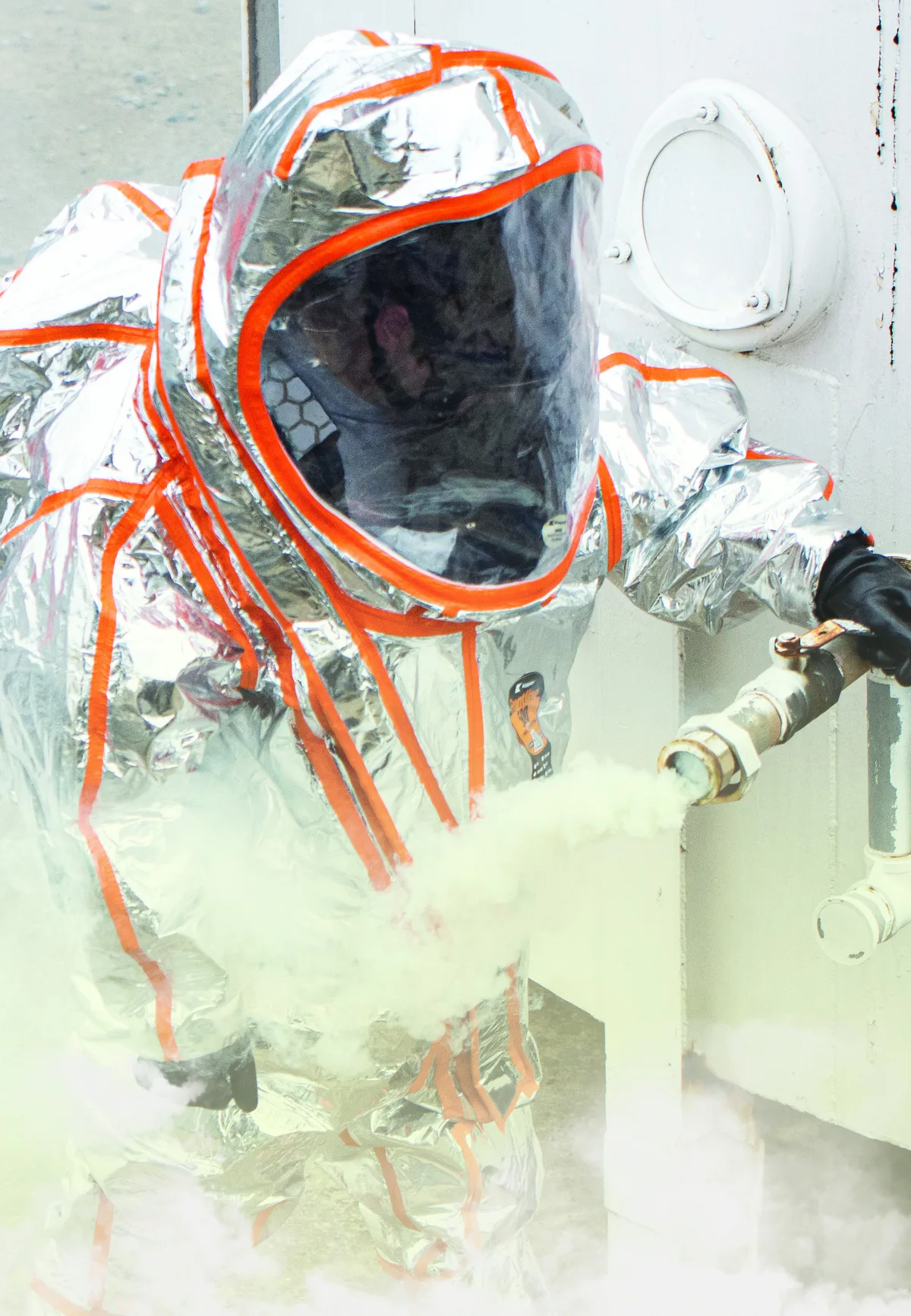
    Responder in a silver Kappler Frontline 500 vapor suit with orange seam tape closing a leaking valve in a cloud of vapor
    Hazmat responseChemical handling · flash-fire potential
    Models

    Choose your entry

    Every Frontline 500 style is a gas-tight, silver vapor total encapsulating suit with the same construction. The difference is the entry: front entry or rear entry, each with an AquaSeal® gas-tight zipper.

    NFPA 1990 (1991) certified vapor suits

    Certified models F5H582-91 and F5H583-91.

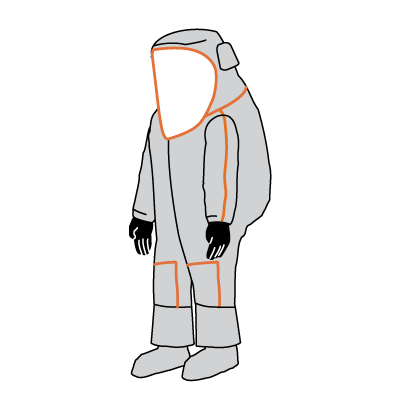
    Illustration of the Frontline 500 F5H582-91 front-entry suit with a diagonal zipper flap across the chestIllustration
    F5H582-91

    Vapor suit · front entry

    NFPA 1990 (1991) certifiedVaporTotal encapsulating

    Frontline® 500 NFPA 1990 (1991) Certified Vapor Total Encapsulating Suit with a Front Entry AquaSeal® Gas-Tight Zipper.

    Sizes
    SM/MD · LG/XL · 2X/3X · 4XL
    Color
    Silver
    View sizes & pricing
    Illustration of the Frontline 500 F5H583-91 rear-entry suit with a clean front panelIllustration
    F5H583-91

    Vapor suit · rear entry

    NFPA 1990 (1991) certifiedVaporTotal encapsulating

    Frontline® 500 NFPA 1990 (1991) Certified Vapor Total Encapsulating Suit with a Rear Entry AquaSeal® Gas-Tight Zipper.

    Sizes
    SM/MD · LG/XL · 2X/3X · 4XL
    Color
    Silver
    View sizes & pricing
    Built into every style
    • AquaSeal® Gas-Tight Zipper
    • Double Storm Flaps with FR Hook & Loop Closure
    • Expanded View AntiFog Visor System with Additional FEP Overlay
    • Expanded Back
    • Field Replaceable 2N1® Glove System and Removable Overgloves
    • Attached Sock Booties with Splash Guards
    • Knee Reinforcements
    • 2 Exhaust Valves
    • Heat Sealed / Taped on Inner and Outer Seams
    F5Fabric family & specific fabricF = Frontline®
    HSeam typeHeat Sealed/Taped
    5Garment typeExpanded Back Encapsulating Suits
    82 / 83Specific garment IDF5H582 = front entry, F5H583 = rear entry
    -91NFPA standardNFPA 1990 (1991)

    Reading the style number

    Three-way protection

    Chemical. Flame. Radiant heat.

    Frontline 500 offers proven three-way protection: broad chemical holdout, plus flame resistance and radiant heat protection for the additional hazards encountered in a chemical flash fire.

    01 · Chemical

    Broad holdout

    Frontline 500 provides excellent holdout for the ASTM F1001 battery and many additional chemicals, and meets NFPA 1990 (1991), including base requirements plus optional Flash-Fire and Liquified Gas requirements.

    NFPA 1990(1991) · base + optional Flash-Fire and Liquified Gas
    02 · Flame

    Flame resistant

    Frontline 500 meets the requirements for flame resistance in accordance with ASTM F1358.

    ASTM F1358Flame resistance · meets requirements
    03 · Radiant heat

    Thermal protective performance

    Frontline 500 has been tested for thermal protective performance (TPP) in accordance with ISO 17492, Clothing for Protection Against Heat and Flame, and showed a TPP value of 32.

    TPP 32ISO 17492
    Instrumented manikin · ASTM F1930
    0%Body burn
    after a six-second
    burn test
    0 s6 sEXPOSUREILLUSTRATION

    Frontline 500 has been tested in accordance with ASTM F1930, Standard Test Method for Evaluation of Flame Resistant Clothing for Protection Against Flash Fire Simulations Using an Instrumented Manikin. The Frontline 500 ensemble garment indicated 0% body burn after a six-second burn test. Kappler's focus on user survivability included Pyroman Thermal Manikin testing in addition to the NFPA 1990 (1991) Chemical Flash Fire Option.

    For escape only
    Frontline garments are designed for chemical flash-fire protection FOR ESCAPE ONLY in the event of a chemical flash fire.

    CAUTION: These garments are designed for protection of personnel against short duration thermal exposures. Do not use for firefighting applications. Minimize exposure to open flame or intense heat.

    ApplicationsHazmat response and chemical handling situations with potential for chemical flash-fire.
    Construction

    See out. Seal in.

    Kappler's AntiFog Expanded-View Visor is standard on all gas-tight suits, including NFPA-certified styles. On Frontline 500 it sits in a suit built around a gas-tight zipper, a field-replaceable glove system and heat-sealed seams.

    Clear AntiFog visor: the wearer's face and SCBA facepiece are fully visible through the suit visor
    AntiFog
    Standard visor fogged over, hiding the wearer's face behind condensation
    Standard

    Comparison shows AntiFog vs. Standard Visor.

    AntiFog Expanded-View Visor System

    The expanded-view AntiFog visor system enhances responder safety. Three layers make up the visor:

    ILLUSTRATION · OUTSIDE INSIDE · WEARER 5 mil FEPouter 40 mil FR PVCmiddle 2 mil anti-fog treatedinner
    PFASFrontline 500 fabric does not contain PFAS Chemistry. PFAS found in FEP lens at this time. Kappler states that the PFAS in the outer layer of its gas-tight visor system contains no PFOA or PFOS, and that this material does not have sustained contact with the wearer's skin.
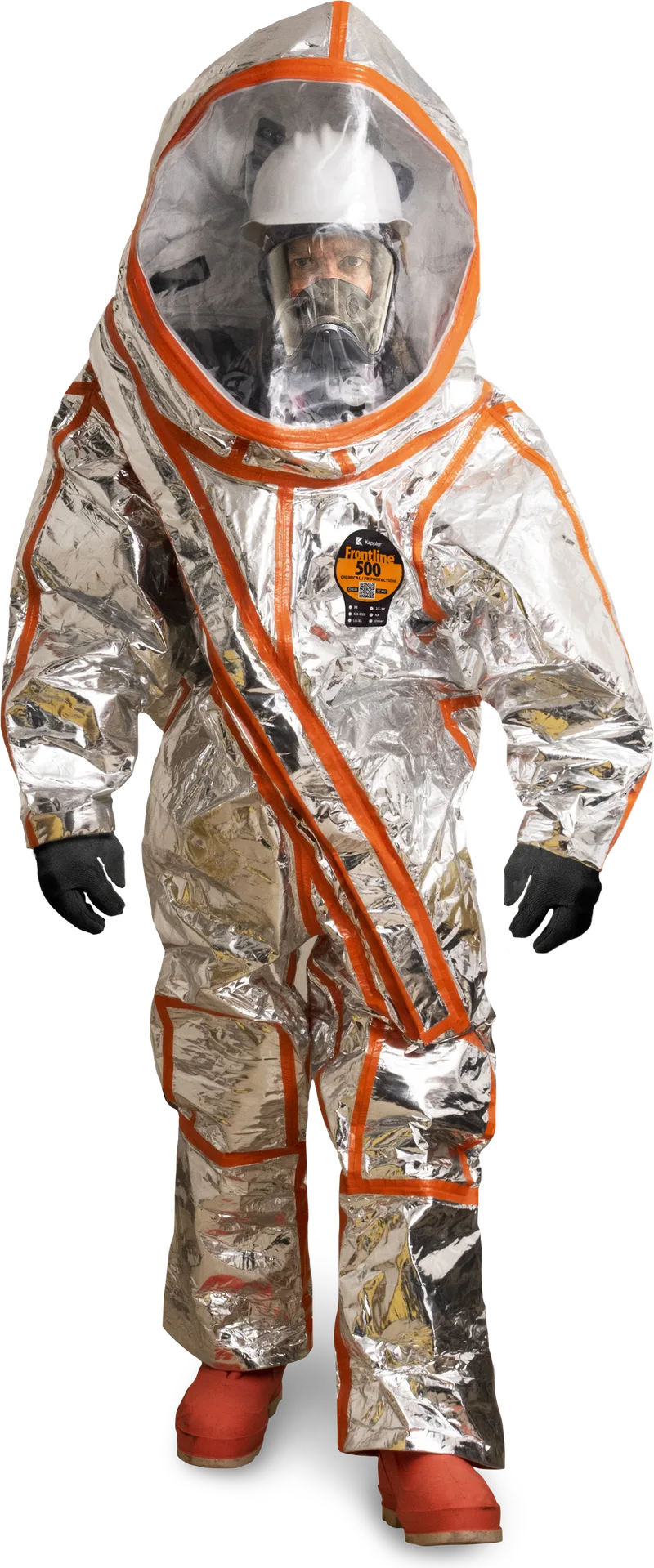
    Full-length Kappler Frontline 500 front-entry suit worn with SCBA and helmet, orange seam tape, black overgloves and orange outer boots 1 2 3 4 5 6
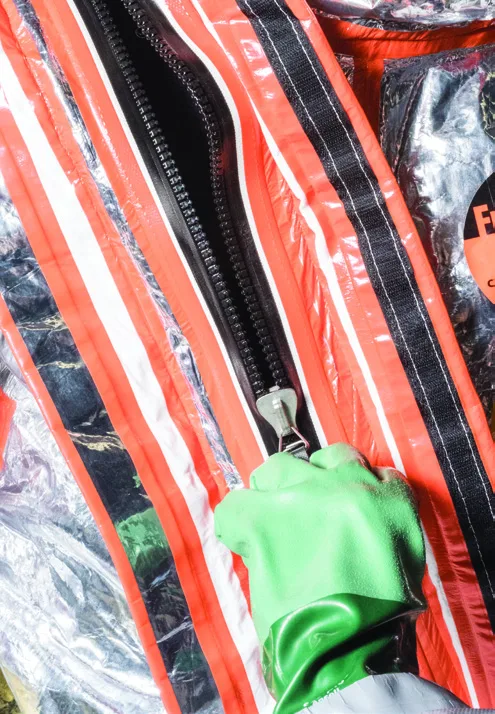
    Gloved hand closing the black AquaSeal gas-tight zipper between orange-taped storm flaps

    AquaSeal® gas-tight zipper, shown closing under the storm flaps

    • 1

      Expanded-View AntiFog visor

      2 mil anti-fog treated inner, 40 mil FR PVC middle and 5 mil FEP outer, with an additional FEP overlay.

    • 2

      SMART™ label

      Makes sizing easy to see, and a quick QR code scan provides complete chemical data plus extensive suit details.

    • 3

      AquaSeal® gas-tight zipper

      Highly flexible, making donning, doffing and pressure testing much easier. Polyurethane coated with heavy duty molded nylon teeth and stainless steel slider components, protected by double storm flaps with FR hook & loop closure.

    • 4

      2N1® Glove System

      Field-replaceable, eliminating the problem of inner glove inversion, plus removable overgloves. Three layers: PE/EVOH laminate inner, 35 mil butyl middle, Kevlar® or Kevlar® and leather tip outer. Connected to the sleeve via a steel clamp/PVC ring.

    • 5

      Expanded back and knee reinforcements

      An expanded-back encapsulating cut, with reinforcement at the knees.

    • 6

      Sock booties with splash guards

      An integrated sock bootie of Zytron® 500 material. Separate outer safety boots must be worn over it.

    • +

      Two exhaust valves

      Impact resistant plastic body and silicon rubber diaphragm, attached by a mechanical screw compression seal, with splash resistant covers of the primary garment material.

    • +

      Heat-sealed seams

      Single needle lock stitch with nylon thread; chemical barrier film tape heat-sealed over the inside seam. Heat Sealed / Taped on Inner and Outer Seams.

    Chemical test data

    Holdout, measured

    Frontline 500 provides excellent holdout for the ASTM F1001 battery and many additional chemicals, with warfare agent data alongside.

    ChemicalASTM F1001 Chemical Test BatteryMinutes
    • Acetone>480
    • Acetonitrile>480
    • Carbon Disulfide>480
    • Dichloromethane253
    • Diethylamine>480
    • Dimethylformamide>480
    • Ethyl Acetate>480
    • n - Hexane>480
    • Methyl Alcohol>480
    • Nitrobenzene>480
    • Sodium Hydroxide>480
    • Sulfuric Acid>480
    • Tetrachloroethylene>480
    • Tetrahydrofuran>480
    • Toluene>480
    Gases
    • Ammonia Gas>480
    • 1,3 Butadiene Gas>480
    • Chlorine Gas>480
    • Ethylene Oxide Gas>480
    • Hydrogen Chloride Gas>480
    • Methyl Chloride Gas>480
    0240480 min
    Chemical Warfare Agent Data

    Agent breakthrough

    Chemical AgentMinutesCriteria
    Bis (2-chloroethyl) sulfide (Mustard:HD)>4804.0 ug/cm2
    Isopropyl methylfluorophosphonate (Sarin:GB)>4801.25 ug/cm2
    O-ethyl S-(2-diisopropylaminoethyl) methylphosphonothiolate (Nerve:VX)>4801.25 ug/cm2

    Industrial chemical testing was conducted in accordance with ASTM F739 with normalized breakthrough times reported in minutes. Chemical Warfare Agent testing was conducted in accordance with MIL-STD-282 and/or NFPA 1990 (1991) with breakthrough times reported based on total cumulative permeation.

    These tests were performed in accordance with ASTM or other appropriate testing methods by independent laboratories. This data is derived from tests performed on material samples only, not finished garments, with exception of Pyroman full-body manikin test.

    Selected additional chemicals

    Permeation based on ASTM F739, results in minutes. Sources for all chemical test data are independent laboratories; tests were performed under laboratory conditions on material samples, not actual garments. Ask us for results on a specific chemical.

    Acids & oxidizers
    Chemical NameCASResult
    Bromine7726-95-680
    Chlorosulfonic Acid7790-94-5>480
    Hydrochloric Acid, 37%7647-01-0>480
    Hydrofluoric Acid 48%7664-39-3>480
    Hydrogen Peroxide, 30%7722-84-1>480
    Nitric Acid, 70%7697-37-2>480
    Oleum (27% SO3)8014-95-7>480
    Sodium Hypochlorite, 13%7681-52-9>480
    Fuels & solvents
    Chemical NameCASResult
    Benzene71-43-2>480
    Carbon Tetrachloride, 99.5%56-23-5>480
    Diesel Fuel Ultra Low SulfurMixture>480
    Gasoline8006-61-9>480
    JP 8 Jet Fuelmixture>480
    Methyl Ethyl Ketone78-93-3>480
    Methyl tert Butyl Ether1634-04-4>480
    Trichloroethylene79-01-6>480
    Toxic industrial gases & reactives
    Chemical NameCASResult
    Acrolein107-02-8>480
    Acrylonitrile107-13-1>480
    Boron Trifluoride7637-07-2>480
    Hydrogen Fluoride Gas 99%7664-39-3>480
    Hydrogen Sulfide 100% Vapor7783-06-4>480
    Methyl Hydrazine 98%60-34-4>480
    Nitrogen Dioxide10102-44-0>480
    Phosphorous Oxychloride10025-87-3>480
    Titanium Tetrachloride7550-45-0>480
    Toluene-2,4-diisocyanate584-84-9>480
    Use & care

    Wear it as certified

    Vapor protective garments totally enclose the wearer and isolate the wearer from exposure to outside gases and vapors. Frontline 500 must be used in combination with additional PPE.

    Respiratory protection

    Separate NIOSH approved full-face respiratory protection such as SCBA, or an external breathing air supply with escape bottle. Certified ensembles must be used with NIOSH CBRN approved SCBA. The SCBA tested with this ensemble was the Scott AV 3000 HT Sure Seal.

    Outer boots

    The OnGuard HazMax #87012 or Tingley #82330 boot must be worn over the integrated bootie for compliance to NFPA 1990 (1991) - 2022.

    Supplied air

    To connect to an external supplied airline system, these garments must be equipped with the appropriate NIOSH approved garment pass-through.

    Underneath

    The wearer should consider wearing inherently flame resistant, woven clothing, with long sleeves and pants under this garment.

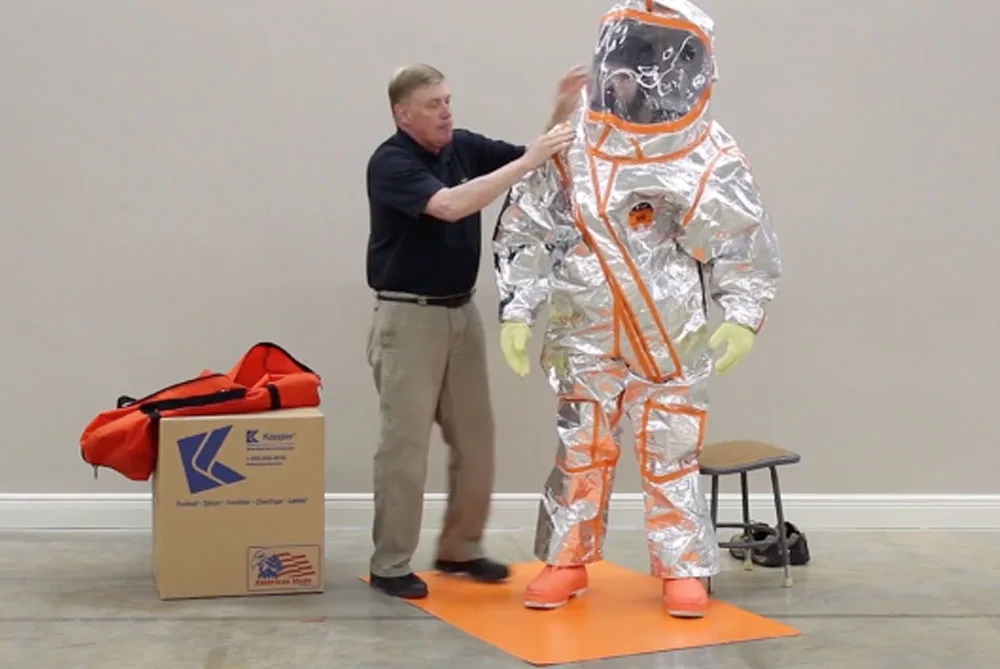
    An assistant helping a responder don a silver Frontline 500 suit on an orange mat, with a carry bag and suit box beside them Assisted donning

    Pressure test, the ASTM F1052 way

    Kappler's pressure test procedure mirrors ASTM F1052, Standard Test Method for Pressure Testing Vapor Protective Ensembles, and requires an external air supply.

    ILLUSTRATION · INCHES OF WATER COLUMN 5.04.03.2 InflateReduce4 minutesRead gauge pass line

    Inflate the garment to a pressure of 5.0 inches of water column, then reduce the air pressure to 4.0 inches of water column. After four (4) minutes, read the air pressure gauge. If the pressure has not dropped below 3.2 inches water column, the garment has passed.

    Inspect

    Full visual inspection

    1. Upon receipt
    2. Prior to donning
    3. After a garment is worn and before it is made available for reuse
    4. Annually
    Use

    Multi-use, single exposure

    This garment is designed for multiple uses, single exposure. It is not designed to be repaired. Contaminated garments should be discarded.

    Decon

    Water and mild dish liquid

    The only decontamination solutions to use with this garment are water and mild household dishwashing liquid. Retired garments that are not contaminated may be labeled and used "For Training Use Only."

    Store

    10-year storage life

    A predicted storage life of 10 years from the date of manufacture when stored properly, based on accelerated aging studies. Store away from direct sunlight or UV, in a cool (40º–90º F), dry, well-ventilated location, with the closures in the open position.

    Specifications

    Frontline 500 specs

    Line-level construction, test and sizing data that applies to every Frontline 500 style.

    Garment
    Primary materialKappler Frontline® 500 chemical barrier fabric
    Fabric colorSilver
    Garment typeVapor Total Encapsulating Suit · Expanded Back
    EntryFront entry (F5H582-91) or rear entry (F5H583-91) AquaSeal® Gas-Tight Zipper
    SeamsSingle needle lock stitch seam, nylon sewing thread; chemical barrier film tapes heat-sealed over the inside seam. Heat Sealed / Taped on Inner and Outer Seams.
    ReinforcementKnee Reinforcements
    LabelSMART™ label with QR code
    Visor
    Visor systemExpanded View AntiFog Visor System with Additional FEP Overlay
    Layers2 mil anti-fog treated inner, 40 mil FR PVC middle and 5 mil FEP outer
    Closure
    ZipperAquaSeal® gas-tight polyurethane coated zipper with heavy duty molded nylon teeth; stainless steel slider components
    FlapDouble Storm Flaps with FR Hook & Loop Closure, composed of garment material
    PermeationThe Zipper/Closure system has not been tested for permeation resistance.
    Gloves, boots & valves
    Glove systemField Replaceable 2N1® Glove System and Removable Overgloves
    Glove layers
    • Inner glove: PE/EVOH Laminate
    • Middle glove: 35mil butyl
    • Outer glove: Kevlar® or Kevlar® and leather tip glove
    These gloves are unlined and have no surface treatments applied.
    Glove attachmentSteel clamp/PVC ring via mechanical screw compression
    FootwearAttached Sock Booties with Splash Guards: integrated sock bootie of Zytron® 500 material; separate outer safety boots required
    Exhaust valves2 Exhaust Valves: impact resistant plastic valve body, silicon rubber diaphragm, mechanical screw compression seal, splash resistant covers of the primary garment material
    Certification
    NFPAMeets requirements of NFPA 1990 (1991), including base requirements plus optional Flash-Fire and Liquified Gas requirements
    Certified modelsF5H582-91 · F5H583-91
    Heat, flame and thermal
    TPP (ISO 17492)32
    Flame resistanceMeets the requirements for flame resistance in accordance with ASTM F1358
    Flash fire manikin (ASTM F1930)0% body burn after a six-second burn test (Frontline 500 ensemble garment). For escape only in the event of a chemical flash fire; do not use for firefighting applications.
    Chemical
    Industrial chemicalsASTM F739, normalized breakthrough times in minutes; ASTM F1001 Chemical Test Battery
    Chemical warfare agentsMIL-STD-282 and/or NFPA 1990 (1991), breakthrough times based on total cumulative permeation
    PFASFrontline 500 fabric does not contain PFAS Chemistry. PFAS found in FEP lens at this time.
    Integrity
    Pressure testProcedure mirrors ASTM F1052. Inflate to 5.0 inches of water column, reduce to 4.0; pass if the pressure has not dropped below 3.2 inches water column after four (4) minutes
    NFPA 1990 (1991) requirements — Hazardous Materials and CBRN Operations Vapor and Liquid
    Chemical resistance vs garment fabric, seams, visors, gloves, bootsPermeation resistance 1 hr vs 21 industrial chemicals, 4 toxic industrial chemicals and agents mustard and soman
    Chemical challenge levelLiquids 100 g/m2 Concentration · Vapors 100%
    Chemical breakthrough criteriaASTM F739 Cumulative (ug/cm2) 6.0 TIC's, 4.0 mustard, 1.25 soman
    System testsASTM F1052 Pressure · MIST Inward Leakage PPDF > 488 · Shower > 60 min
    Flame resistance and flame break open resistanceASTM F1358 3 sec burn only · FTM 191A
    Flash fire/thermal protection (standard requirement)Optional requirement of the standard · ASTM F1358 12 sec burn · ASTM F2700 > 8 cal/cm2
    ComfortN/A

    Requirements of the standard. Frontline 500 is certified to NFPA 1990 (1991) including the optional Flash-Fire and Liquified Gas requirements; flash-fire protection is for escape only.

    Sizing
    Available sizesSM/MD, LG/XL, 2X/3X, 4XL
    Combination sizingTypically worn over other clothing, Kappler's garments are designed so that "combination sizes" comfortably fit the vast majority of users.
    Storage & use
    Storage lifePredicted storage life of 10 years from the date of manufacture when stored properly, based on accelerated aging studies
    Storage conditionsAway from direct sunlight or UV exposure; cool (between 40º -90º F), dry, well-ventilated location; in original boxes, in bags, or on hangers, with the closures in the open position
    UseMultiple uses, single exposure; not designed to be repaired
    DecontaminationWater and mild household dishwashing liquid only
    FAQ

    Frontline 500 questions

    What is the difference between F5H582-91 and F5H583-91?
    The entry. F5H582-91 has a front entry AquaSeal® gas-tight zipper; F5H583-91 has a rear entry AquaSeal® gas-tight zipper. The rest of the construction is the same: expanded-view AntiFog visor with FEP overlay, expanded back, field-replaceable 2N1® glove system with removable overgloves, attached sock booties with splash guards, knee reinforcements, two exhaust valves and heat sealed/taped seams. Compare the models.
    Can Frontline 500 be used for firefighting?
    No. Frontline garments are designed for chemical flash-fire protection for escape only in the event of a chemical flash fire. They are designed for protection of personnel against short duration thermal exposures. Do not use for firefighting applications, and minimize exposure to open flame or intense heat.
    What does NFPA 1990 (1991) mean?
    The NFPA protective clothing standards are now consolidated under NFPA 1990, which includes the former 1991, 1992 and 1994 standards. "(1991)" refers to the Hazardous Materials and CBRN Operations vapor and liquid requirements. Frontline 500 meets NFPA 1990 (1991), including base requirements plus optional Flash-Fire and Liquified Gas requirements. Flash-fire protection is for escape only; do not use for firefighting applications. The certified models are F5H582-91 and F5H583-91.
    What respirator and boots do I need?
    Certified ensembles must be used with NIOSH CBRN approved SCBA; the SCBA tested with this Frontline® ensemble was the Scott AV 3000 HT Sure Seal. The suit has an integrated sock bootie, and the OnGuard HazMax #87012 or Tingley #82330 boot must be worn over it for compliance to NFPA 1990 (1991) - 2022.
    Can the suit be reused?
    Frontline 500 is a "multi-use, single exposure" garment: designed for multiple uses, single exposure. It is not designed to be repaired, and contaminated garments should be discarded. Inspect it upon receipt, before donning, after it is worn and before reuse, and annually. Retired garments that are not contaminated may be labeled and used "For Training Use Only."
    Does Frontline 500 contain PFAS?
    Frontline 500 fabric does not contain PFAS Chemistry. PFAS found in FEP lens at this time. Kappler states that the PFAS in the outer layer of its gas-tight visor system contains no PFOA or PFOS, the two PFAS compounds of greatest concern, and that the material does not have sustained contact with the wearer's skin.
    How long can a Frontline 500 suit be stored?
    Frontline® 500 garments have a predicted storage life of 10 years from the date of manufacture when stored properly, based on accelerated aging studies. Store them away from direct sunlight or UV exposure, in a cool (between 40º -90º F), dry, well-ventilated location, with the closures in the open position.
    Which sizes are available?
    SM/MD, LG/XL, 2X/3X and 4XL. Kappler's garments are designed so that "combination sizes" comfortably fit the vast majority of users, typically worn over other clothing. Each style's listing shows its sizes: see Models.
    Next step

    Outfit your team in Frontline 500

    Tell us which style you need, front or rear entry, with sizes and quantities, and we will come back with a quote.

    CONTACT US