Overview
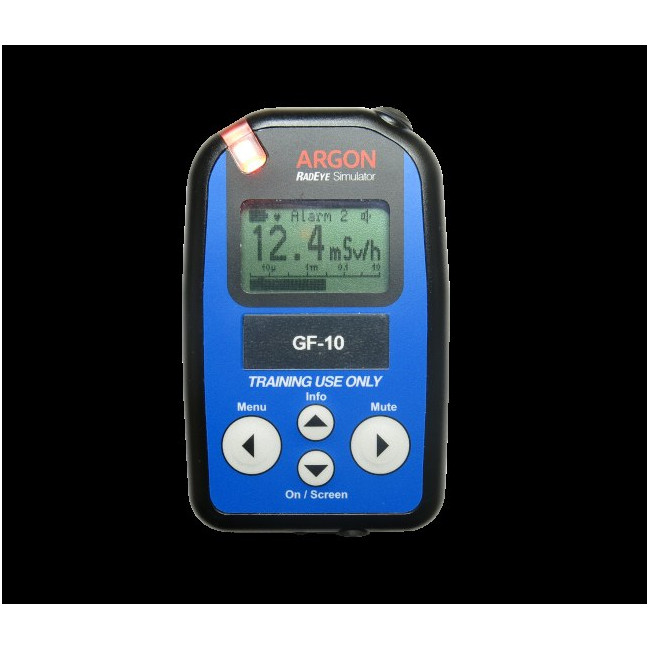
The RadEye™ GF-10 Simulator is an ultra-realistic training solution designed to replicate the functionality and response of the Thermo Fisher RadEye™ GF-10 radiation detector. Built for high-fidelity radiation detection exercises, this simulator eliminates risks associated with ionizing radiation while providing a safe, effective, and environmentally friendly training environment. Features identical user interface components (display, switches, sounder, vibrator) as the operational detector, realistic inverse square law response within actual detector tolerances, and seamless integration with Argon’s Plume SIM for wide-area CBRN and HazMat exercises. No radioactive materials, calibration, or preventative maintenance required.
Running a gamma drill without a live source
Instructors set out an Argon Radsim GS4 gamma source in place of radioactive material. The simulator picks it up from about 200 feet (60 meters) away, which leaves room for realistic search and approach drills. Readings follow the inverse square law within actual detector tolerances, so trainees see the numbers climb as they close distance, just as they would with the real instrument.
What can be set up for a scenario
- Shielding: simulates the trainee’s own body shielding and the effect of shielding materials
- Units: Sv/hr, Rem or CPS, to match the units your agency uses
- Alarms: dose and dose rate alarm points can be customized
- Language: selectable on the unit
Scaling up to a full exercise
The GF-10 SIM is fully compatible with Argon’s Plume SIM, so it can join multi-device, wide-area CBRN and hazmat exercises alongside other simulated instruments. Because the display, switch panel, sounder and vibrator match the operational RadEye GF-10, the button presses and alerts practiced in training carry over to the detector on the truck.
Frequently asked questions
Does the RadEye GF-10 simulator use any radioactive material?
No. The simulator uses no radioactive materials and needs no calibration or preventative maintenance. It responds to an Argon Radsim GS4 gamma source, which it detects at roughly 200 feet (60 meters), and models inverse square law and shielding effects within actual detector tolerances.
Will trainees see the same screen and alerts as a real RadEye GF-10?
Yes. The display, switch panel, sounder and vibrator are identical to the operational RadEye GF-10. Instructors can set the measurement units to Sv/hr, Rem or CPS, choose the language, and customize dose and dose rate alarms to match local procedures.
- Realistic inverse square law response within actual detector tolerances
- Simulates user body shielding and shielding material effects
- Identical display, switch panel, sounder, and vibrator as operational RadEye™ GF-10
- Configurable measurement units (Sv/hr, Rem, CPS)
- Language selection capability
- Customisable dose and dose rate alarms
- Detects Radsim GS4 gamma source at approximately 200 feet (60 metres) distance
- Fully compatible with Argon's Plume SIM for multi-device exercises
- No preventative maintenance or calibration required
- No radioactive materials used