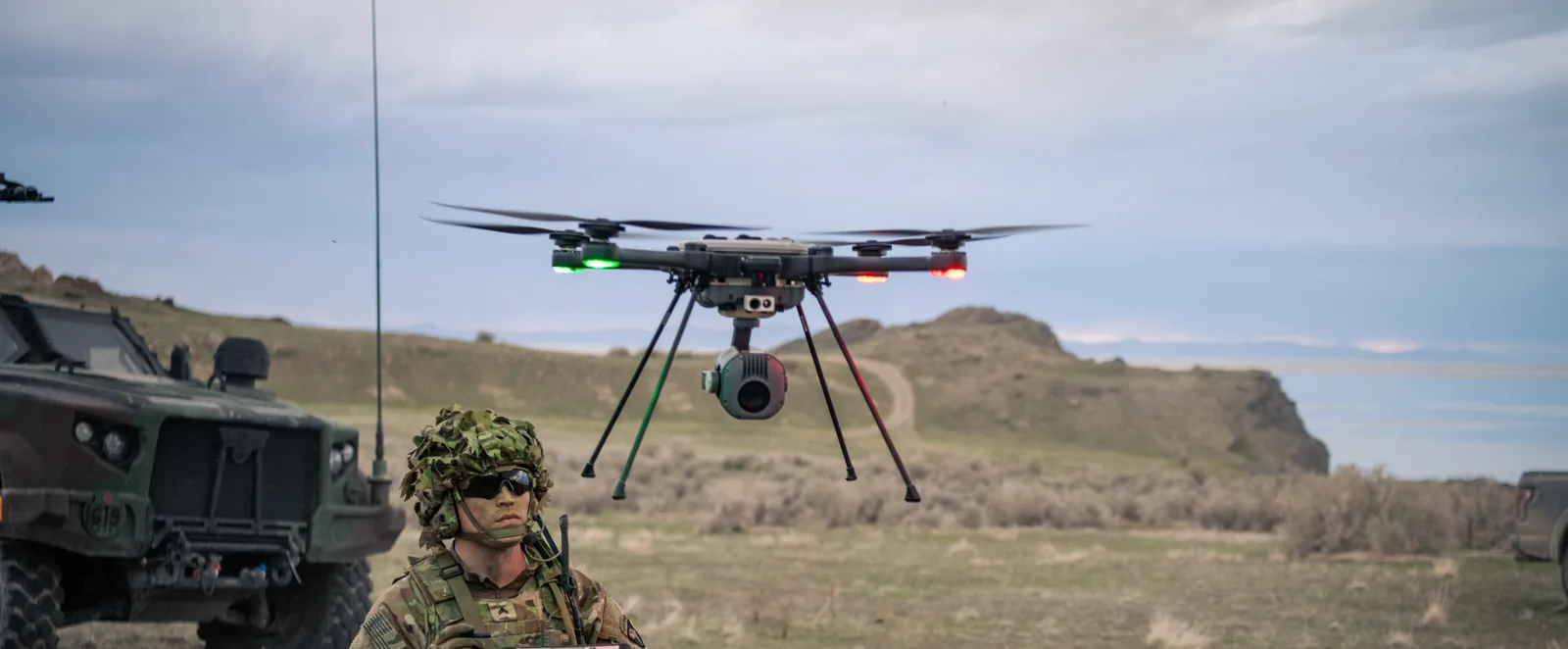
Who is the R80D SkyRaider developed for?
In Teledyne FLIR’s words, the R80D was “Developed for U.S. Defense and Federal Government Customers”, and its RaiderOS was “Developed exclusively for U.S. DOD and Federal Agencies operating the R80D.” Contact FarrWest to discuss eligibility:
210.566.1857 or
sales@farrwest.com.
Which imaging payloads does the R80D support?
Day Imager: StormCaster-T, EO/IR MK-II, HD40-XV. Night Imager: StormCaster-T, EO/IR MK-II. Payloads are hot-swappable. FarrWest lists the
StormCaster-T and
EO/IR Mk II.
How much can the R80D carry?
With the Osprey it can carry, drop and emplace up to 7.7 lbs (3.5 kg). Custom payloads are supported through the Payload Development Kit (PDK). The aircraft itself weighs 11 lbs (5kg).
How long can it stay in the air?
Typical endurance is over 40 minutes with the standard propulsion system. A
Tether Kit is available for persistent operations; it connects through a ruggedized connector on the latest R80D airframe.
Can it fly without GPS or an active command link?
Four dedicated computer vision cameras enable flights in GPS-denied environments, and the R80D is able to execute semi-autonomous missions without an active command link for operations in RF-denied environments.
What weather can it handle?
It is rated for -4°F to 122°F (-20°C to 50°C), 40mph sustained, 56mph gusting (65kph, 90kph) winds, and “Tested to IP-54 and military standards” for precipitation. It can operate up to 15,000’ MSL.
Is the R80D export controlled?
Teledyne FLIR states the product information may be subject to the International Traffic in Arms Regulations (ITAR) or the Export Administration Regulations (EAR) “depending upon specifications for the final product; jurisdiction and classification will be provided upon request.”