No products in the cart.

  • Teledyne FLIR / Radionuclide identification device (RID)

    FLIR identiFINDER R425

    Next Generation Radionuclide Identification Device

    Teledyne FLIR calls the identiFINDER R425 the next generation of the most deployed radionuclide identification device (RID). It offers 360-degree coverage so you can locate and measure radioactive sources, built with Teledyne FLIR’s algorithms with advanced heuristics and hybrid identification techniques. Every model detects gamma; neutron detection is on the GN and LGN models only.

    360°Coverage to locate and measure sources
    1024Channel gamma spectrum
    ≤2.6 lbs(≤1.2 kg) weight
    IP67According to IEC 60529
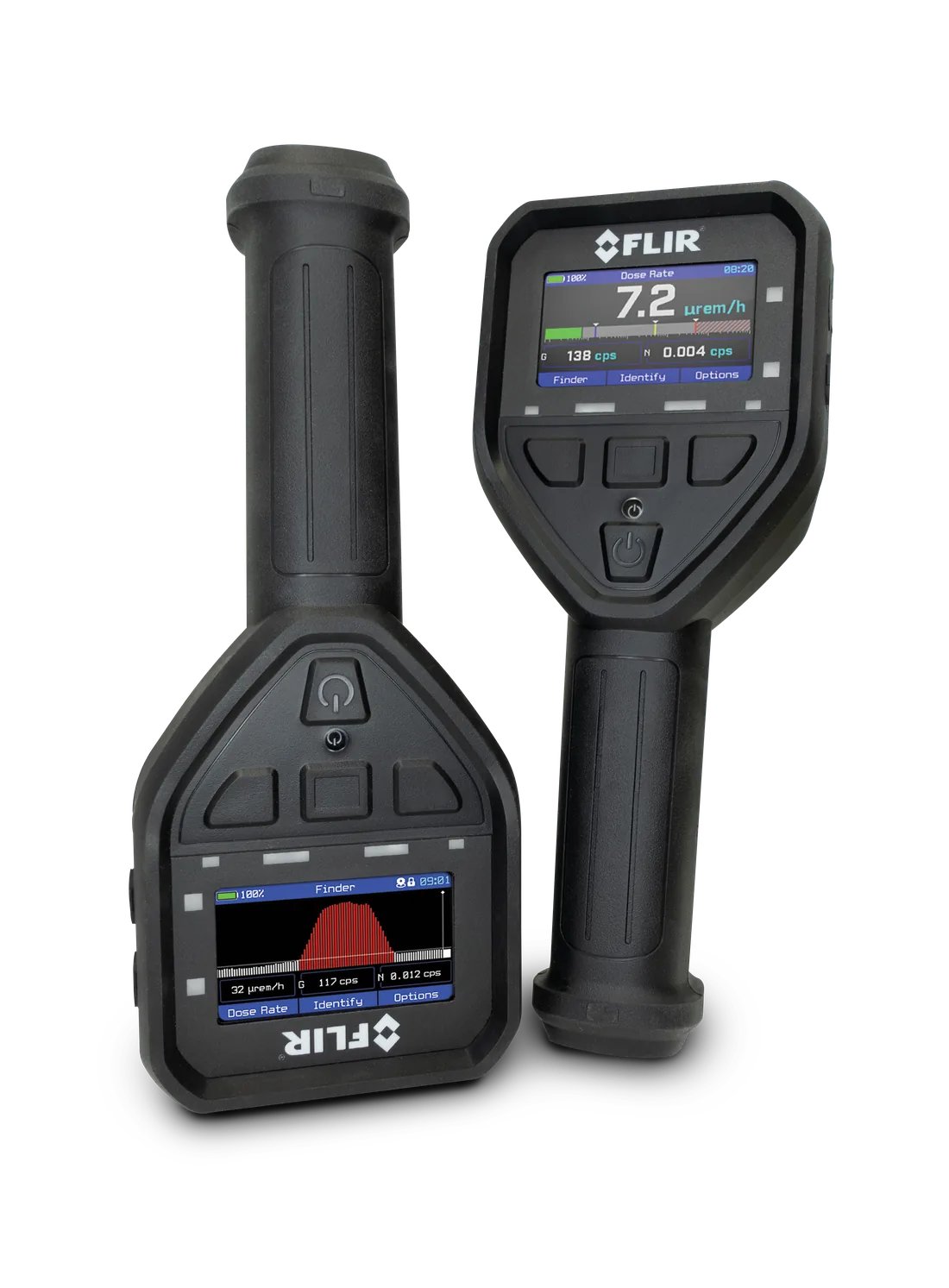
    Two FLIR identiFINDER R425 handhelds, one showing the Dose Rate screen and one showing the Finder screen
    3-button controlFamiliar identiFINDER user interface
    2.7” screenSunlight readable, visible through polarized glasses
    Responder holding an identiFINDER R425 beside a damaged vehicle
    High gamma fields

    “When other systems fail in extremely high gamma fields, the identiFINDER R425 provides pinpoint accuracy and remains fully operational.”

    Teledyne FLIR

    Teledyne FLIR says the R425 provides an ideal balance of size, weight, and performance for three kinds of work:

    • Surveying
    • Emergency response
    • Environmental monitoring
    From the R400 to the R425

    Same interface. Next generation.

    The R425 keeps the familiar identiFINDER user interface and 3-button control. Teledyne FLIR’s updates are in the detector, the dose capability and the screen cover.

    Gloved hand holding an identiFINDER R425 showing its Finder screen and 3-button keypad
    Finder screen and 3-button control

    “Same tried and trusted interface as the R400. Pick it up and go.”

    Teledyne FLIR
    • ControlOperate the R425 quickly with the familiar identiFINDER user interface and 3-button control.
    • Operator training<10 mins for operator; 1 hour for advanced user
    • Display2.7” diagonal (400x240 pixels) screen; sunlight readable; visible through polarized glasses
    • SoftwareOnboard webserver software
    Sibling pageRunning identiFINDER R400 units? See the R400 page.
    What changed

    The updates Teledyne FLIR lists

    25,000+“With over 25,000 deployed RIDs, the R425 builds on a solid legacy of performance in every way.”
    • Glass

      New glass screen cover

      Added to boost its ruggedness.

    • GM tube

      Higher dose capability

      An increased-range GM tube adds higher dose capability. High dose rate range: 1 - 100 rem/h ± 30% (10 mSv/h - 1 Sv/h ± 30%).

    • ≤ 4.5%

      LaBr detector option

      An LaBr detector offering higher resolution, providing a better energy resolution capability: ≤ 4.5% FWHM at 662 keV (20°C).

      LG & LGN models
    • 75%

      Larger detector

      Greater sensitivity with a 75% larger detector.

    • 2X

      Neutron sensitivity

      Teledyne FLIR claims 2X neutron sensitivity. Neutron detection is on the GN and LGN models only, rated ≥ 15 cps/nv.

      GN & LGN models only
    • 15%

      Lighter

      15% lighter weight than the previous generation. The R425 weighs ≤2.6 lbs (≤1.2 kg).

    Measure · locate · identify · report

    From first count to a named nuclide

    “Threats come from every direction,” says Teledyne FLIR, so the R425 uses a cubic detector design for high performance in all directions. Here is the job from survey to reachback.

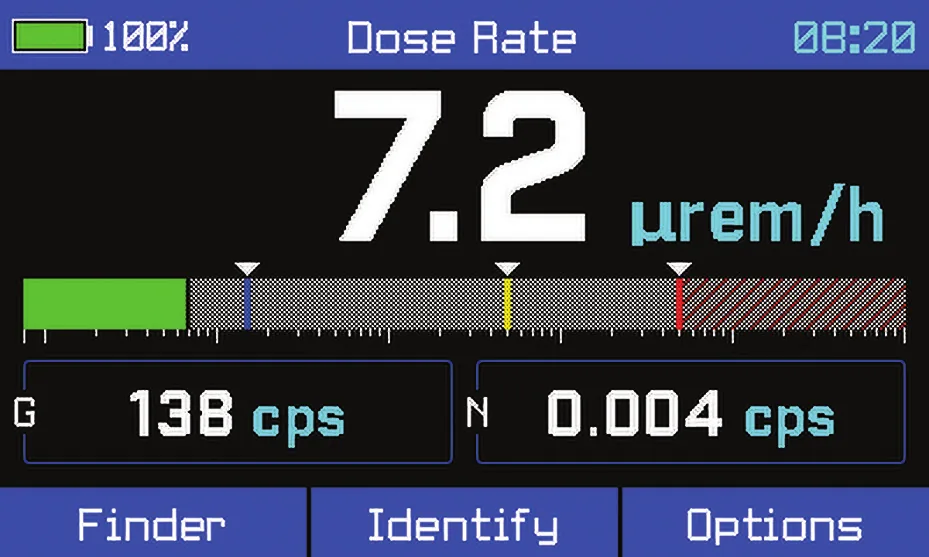
    identiFINDER R425 Dose Rate screen reading 7.2 µrem/h with gamma and neutron count rates
    Step 01 · Dose Rate screen

    Measure the dose rate

    Survey the scene with a dose rate reading, backed by a separate high dose rate gamma detector.

    • Dose rate range (Cs-137)10 µrem/h – 1 rem/h ± 10%
      100 nSv/h – 10 mSv/h ± 10%
    • High dose rate gamma detectorEnergy Compensated Geiger Müller (GM) Tube
    • High dose rate range1 - 100 rem/h ± 30%
      10 mSv/h - 1 Sv/h ± 30%
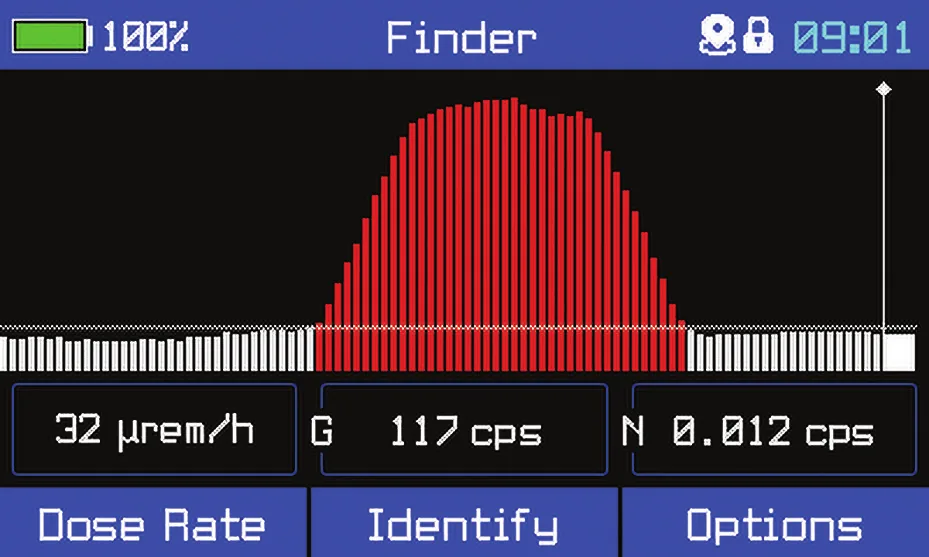
    identiFINDER R425 Finder screen with a red count-rate histogram, 32 µrem/h and gamma and neutron count rates
    Step 02 · Finder screen

    Locate the source

    360-degree coverage so you can locate and measure radioactive sources; the cubic detector design allows for high performance in all directions.

    • Gamma detector, NaI(Tl)1.77 x 1.77 x 1.77 in (45 x 45 x 45 mm) cubic detector with silicon photomultiplier (SiPM)
    • Gamma detector, LaBr3(Ce)1.4 x 1.4 x 1.4 in (35 x 35 x 35 mm) cubic detector with silicon photomultiplier (SiPM)
    20 keV 3 MeV 1024 CHANNELS Illustration
    Step 03

    Identify the nuclide

    Sourceless gain stabilization and real time linearization of gamma energy.

    • Nuclide identificationAccording to ANSI N42.34
    • Library categoriesSNM, IND, MED, NORM
    • Time to identificationFrom a few seconds to a few minutes
    • Dose rate range, ID mode (Cs-137)0.1 µrem/h – 5 mrem/h
      1 nSv/h – 50 µSv/h
    Bluetooth (BLE 5.0)USB-C (2x)ANSI N42.42 files8GB internal memory
    Step 04

    Report & reachback

    “When threat detection occurs, getting results communicated as quickly as possible is critical,” says Teledyne FLIR.

    • RemoteRemote viewing, operation, and reachback over Bluetooth via available app (iOS/Android) or over USB-C via FLIR’s intuitive Web Interface.
    • Data file formatAccording to ANSI N42.42
    • Wi-Fi & cellularWi-Fi and Cellular connectivity via optional adapter.

    Universal API. Teledyne FLIR lists a universal API to enable integration with user deployed networks, naming these examples:

    • Mobile Field Kit
    • ATAC
    • Sigma Edge
    • Safe Environment Gateway
    • and others
    Model variants

    Four configurations, one platform

    The R425 comes as gamma and gamma/neutron models, with gamma detectors in NaI(Tl) or LaBr3(Ce): only the GN and LGN models carry the neutron detector. We will confirm what can be supplied.

    Gamma onlyNo neutron detector
    Gamma + neutronZnS neutron detector
    NaI(Tl)45 mm cubic detector
    GNaI · gamma
    Gamma
    Gamma detector
    1.77 x 1.77 x 1.77 in (45 x 45 x 45 mm) cubic detector with silicon photomultiplier (SiPM)
    Sensitivity (Cs-137)
    1610 cps/uSv/h
    Typical resolution
    ≤ 7% FWHM at 662 keV (20°C)
    Neutron
    Not fitted
    GNNaI · gamma/neutron
    GammaNeutron
    Gamma detector
    1.77 x 1.77 x 1.77 in (45 x 45 x 45 mm) cubic detector with silicon photomultiplier (SiPM)
    Sensitivity (Cs-137)
    1610 cps/uSv/h
    Typical resolution
    ≤ 7% FWHM at 662 keV (20°C)
    Neutron detector
    ZnS, 27 x 58 x 5 mm moderated panels (2 each)
    Neutron sensitivity
    ≥ 15 cps/nv
    LaBr3(Ce)35 mm cubic detector
    LGLaBr · gamma
    Gamma
    Gamma detector
    1.4 x 1.4 x 1.4 in (35 x 35 x 35 mm) cubic detector with silicon photomultiplier (SiPM)
    Sensitivity (Cs-137)
    1000 cps/uSv/h
    Typical resolution
    ≤ 4.5% FWHM at 662 keV (20°C)
    Neutron
    Not fitted
    LGNLaBr · gamma/neutron
    GammaNeutron
    Gamma detector
    1.4 x 1.4 x 1.4 in (35 x 35 x 35 mm) cubic detector with silicon photomultiplier (SiPM)
    Sensitivity (Cs-137)
    1000 cps/uSv/h
    Typical resolution
    ≤ 4.5% FWHM at 662 keV (20°C)
    Neutron detector
    ZnS, 27 x 58 x 5 mm moderated panels (2 each)
    Neutron sensitivity
    ≥ 15 cps/nv
    • Every model · high doseEnergy Compensated Geiger Müller (GM) Tube
    • Every model · energy range20 keV - 3 MeV
    • Every model · spectrum1024 channels
    • Every model · identificationAccording to ANSI N42.34

    NaI(Tl): higher sensitivity

    The G and GN models have the higher Cs-137 gamma sensitivity: 1610 cps/uSv/h, against 1000 cps/uSv/h for the LaBr models.

    LaBr3(Ce): finer resolution

    Teledyne FLIR describes the LaBr detector as the higher resolution option providing a better energy resolution capability: ≤ 4.5% FWHM at 662 keV (20°C), against ≤ 7% for the NaI models.

    Power through your mission

    Built to go the distance

    Teledyne FLIR: “Unparalleled ruggedness, power flexibility, and usability means the R425 will go the distance and complete the mission with you.”

    Firefighter in turnout gear and SCBA mask reading an identiFINDER R425
    identiFINDER R425 in use with SCBA
    • 01

      Rugged enclosure

      Injection molded housing with overmold; rating IP67 according to IEC 60529; MIL-STD 810g Salt / Fog compliant. Fully enclosed solid-state detector, ergonomic design and rubberized grip.

    • 02

      Hot-swappable power

      Internal Li-ion cells; additional user-selectable external battery (1 each 16650 Li-ion or 2 each CR123); hot-swappable. Ready ≤20 seconds from cold start.

    • 03

      Wide operating window

      Operating temperature -22 to 140 °F (-30 to 60 °C) and 0 to 100% operating humidity.

    • 04

      Wall adapter & USB-C

      100-240 AC input, with wall adapter and USB-C cable supplied.

    “Internal battery lasts up to 12 hours. Need more? Hot swappable batteries (rechargeable AND disposables) add 2 hours of use.”Teledyne FLIR
    Specifications

    Key specifications

    For the G, GN, LG and LGN models.

    Detection
    TechnologyRadionuclide identification device (RID); Gamma and Gamma/Neutron Models
    Gamma detector, NaI(Tl) (G & GN models)1.77 x 1.77 x 1.77 in (45 x 45 x 45 mm) cubic detector with silicon photomultiplier (SiPM)
    Gamma detector, LaBr3(Ce) (LG & LGN models)1.4 x 1.4 x 1.4 in (35 x 35 x 35 mm) cubic detector with silicon photomultiplier (SiPM)
    High dose rate gamma detectorEnergy Compensated Geiger Müller (GM) Tube
    Neutron detector, ZnS (GN & LGN models only)27 x 58 x 5 mm moderated panels (2 each)
    Gamma
    Energy range (gamma)20 keV - 3 MeV
    Gamma sensitivity (Cs-137)1610 cps/uSv/h (G & GN models)
    1000 cps/uSv/h (LG & LGN models)
    Typical resolution≤ 7% FWHM at 662 keV (20°C) (G & GN models)
    ≤ 4.5% FWHM at 662 keV (20°C) (LG & LGN models)
    Gamma spectrum length1024 channels
    StabilizationSourceless gain stabilization
    LinearizationReal time linearization of gamma energy
    Neutron
    Neutron sensitivity≥ 15 cps/nv (GN & LGN models only)
    Dose rate
    Dose rate range (Cs-137)10 µrem/h – 1 rem/h ± 10%
    100 nSv/h – 10 mSv/h ± 10%
    Dose rate range ID mode (Cs-137)0.1 µrem/h – 5 mrem/h
    1 nSv/h – 50 µSv/h
    High dose rate range1 - 100 rem/h ± 30%
    10 mSv/h - 1 Sv/h ± 30%
    Identification
    Nuclide identificationAccording to ANSI N42.34
    Library categoriesSNM, IND, MED, NORM
    Time to identificationFrom a few seconds to a few minutes
    Interface & data
    Display & alerts2.7” diagonal (400x240 pixels) screen; sunlight readable; visible through polarized glasses
    CommunicationsUSB-C (2x), Bluetooth (BLE 5.0)
    Data storage8GB internal memory
    SoftwareOnboard webserver software
    Data file formatAccording to ANSI N42.42
    Training requirements<10 mins for operator; 1 hour for advanced user
    Power
    Input voltage100-240 AC (wall adapter and USB-C cable supplied)
    Battery specificationInternal Li-ion cells; additional user-selectable external battery (1 each 16650 Li-ion or 2 each CR123); hot-swappable
    Cold start time≤20 seconds from cold start
    Environment
    Operating temp-22 to 140 °F (-30 to 60 °C)
    Operating humidity0 to 100%
    Storage temperature0 to 140 °F (0 to 60 °C)
    Physical
    Dimensions (L x W x H)9.3 x 3.9 x 3.7 in (235 x 100 x 95 mm)
    Weight≤2.6 lbs (≤1.2 kg)
    Enclosure & protectionInjection molded housing with overmold; rating IP67 according to IEC 60529; MIL-STD 810g Salt / Fog compliant

    Teledyne FLIR: “This product is subject to United States export regulations and may require US authorization prior to export, reexport, or transfer to non-US persons or parties.”

    FAQ

    Questions we get on the phone

    Does every identiFINDER R425 detect neutrons?
    No. The neutron detector (ZnS, 27 x 58 x 5 mm moderated panels, 2 each, with a neutron sensitivity of ≥ 15 cps/nv) is fitted to the GN and LGN models only. The G and LG models detect gamma only.
    How do the NaI and LaBr models compare?
    The NaI(Tl) models (G and GN) list a Cs-137 gamma sensitivity of 1610 cps/uSv/h and a typical resolution of ≤ 7% FWHM at 662 keV (20°C). The LaBr3(Ce) models (LG and LGN) list 1000 cps/uSv/h and ≤ 4.5% FWHM at 662 keV (20°C), which Teledyne FLIR describes as a better energy resolution capability. Request a quote and tell us your application.
    We already use identiFINDER R400s. Will our operators need retraining?
    Teledyne FLIR says the R425 has the “same tried and trusted interface as the R400. Pick it up and go.” Training requirements are <10 mins for operator; 1 hour for advanced user. See the identiFINDER R400 page.
    How long does an identification take?
    From a few seconds to a few minutes. Nuclide identification is according to ANSI N42.34, with library categories SNM, IND, MED, NORM.
    How do results get off the instrument?
    Remote viewing, operation, and reachback over Bluetooth via available app (iOS/Android) or over USB-C via FLIR’s intuitive Web Interface. Data files are according to ANSI N42.42, stored on 8GB internal memory. Teledyne FLIR also lists a universal API for integration with user deployed networks such as Mobile Field Kit, ATAC, Sigma Edge and Safe Environment Gateway, and Wi-Fi and cellular connectivity via an optional adapter.
    How long does it run on a charge?
    Teledyne FLIR states: “Internal battery lasts up to 12 hours. Need more? Hot swappable batteries (rechargeable AND disposables) add 2 hours of use.” The external battery is 1 each 16650 Li-ion or 2 each CR123.
    Is the R425 a current product?
    Yes. The identiFINDER R425 is a current Teledyne FLIR product, and it is available from FarrWest on request. Request a quote and we will follow up.
    Are there export restrictions?
    Teledyne FLIR states: “This product is subject to United States export regulations and may require US authorization prior to export, reexport, or transfer to non-US persons or parties.”
    Next step

    Spec an R425 for your team

    Tell us whether you need gamma-only or gamma/neutron detection, and NaI or LaBr resolution. FarrWest will follow up and confirm what can be supplied.

    CONTACT US