

Mirion Technologies · Radiation detection
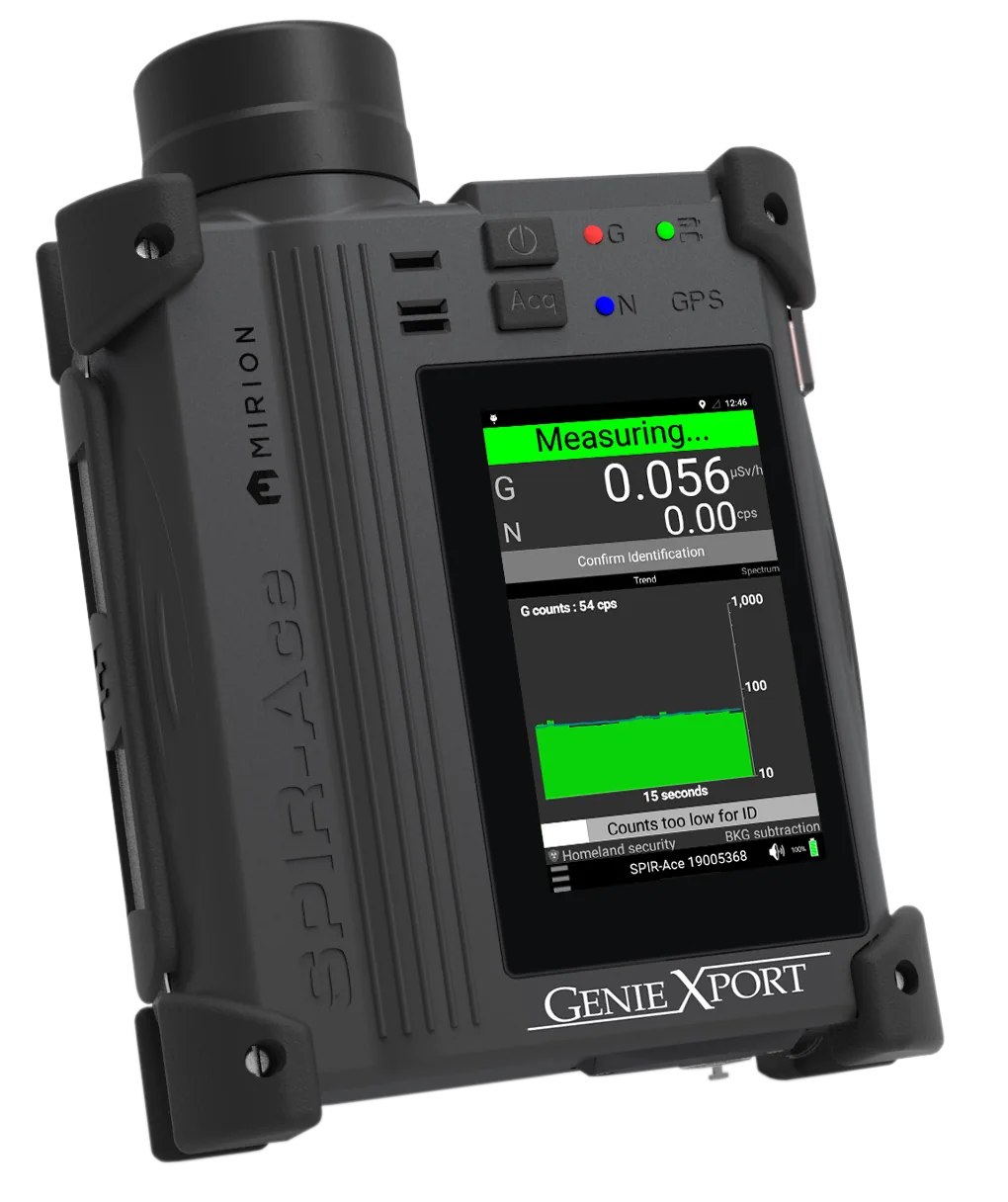
Mirion SPIR-Ace
Radionuclide Identification Device (RIID) with quantitative assessment capability
A versatile, portable RIID for efficient detection and identification of radiological threats in civil defense, border security and customs, law enforcement, emergency response and other critical infrastructure work. Coupled with offline Genie software, the same instrument handles in situ quantitative assessment of nuclear materials for power plants, safeguard inspections and forensic laboratories.
This listing is the NaI(Tl) detector model. LaBr3, integrated neutron, contamination-probe and bundle configurations are available on request. See options.
5–15 sTo identify at 0.5 µSv/h
80Nuclides, seven libraries
8Nuclides at once, max
IP65Water and dust
Detect, locate, identify, quantify
From first alarm to activity report
The SPIR-Ace is built around four steps. The first three run on the device in the field, with no button to touch to read the situation. The fourth hands a longer count to Genie software for confirmation and activity calculation.
-
Step 01 · Passive detection
Detect
Higher gamma or neutron rates activate the screen and generate alarms, while the device provides continuous nuclide identification. It vibrates and triggers configurable visual and sound alarms; low, high and danger alarm levels are adjustable.
- Auto spectrum on alarm
- Display update every 0.25 s
-
Step 02 · Search
Locate
Use the Trend, Radar and Histogram screens to localize a source, and map the geolocation of the hotspot area. Every measurement and event is recorded with its location.
- Trend
- Radar
- Map
- GNSS receiver
-
Step 03 · On-board ID
Identify
Rapid nuclide identification directly on the device: 5 to 15 seconds at a dose rate of 0.5 µSv/h (50 µR/h), up to eight nuclides simultaneously, from seven libraries containing 80 nuclides.
- 1024-channel MCA
- Bare, shielded, mixed
-
Step 04 · With Genie software
Quantify
Acquire spectra for a longer time to improve statistics, then export the CNF file to Genie via USB or email on Wi-Fi for nuclide identification confirmation and activity calculation.
- CNF export
- ISOCS geometries
Search & localize
Walk the reading down to the source
Efficient source localization features with onboard directional radar and radiation mapping. The three search screens below help you find the source; the built-in GNSS receiver geotags what you find.
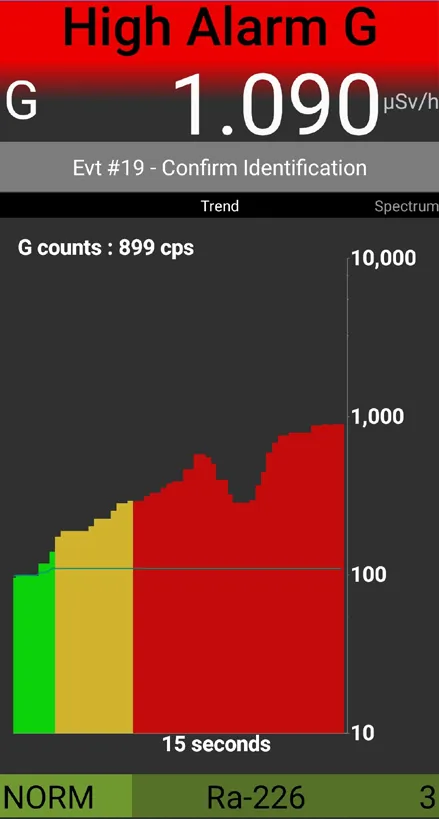
Follow the count rate
The Trend screen helps locate the source, and automated identification may already provide a result.
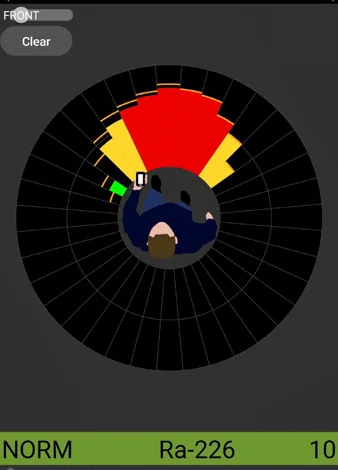
Get a direction
The Radar screen provides direction to the source.
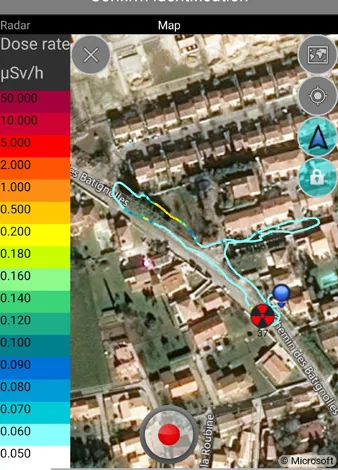
Pin the hotspot
Mapping with hotspot localization, so the geolocation of the hotspot area is on record.
No button to touchThe screen provides all the information to evaluate the situation.
Confirmation measurements for non-expertsNon-expert users can acquire confirmation measurements from all screens. The Spectrum screen is there for advanced and expert users.
Gloves and PPE4.3 in. color touch screen plus two buttons for gloves/Personal Protective Equipment (PPE) operation, and alarm indicators by LEDs, vibrator and sound.
On-board nuclide identification
The hard cases, within a few seconds
Mirion rates the SPIR-Ace's on-device identification beyond current standards for RIIDs, including the scenarios that are hardest to call in the field.
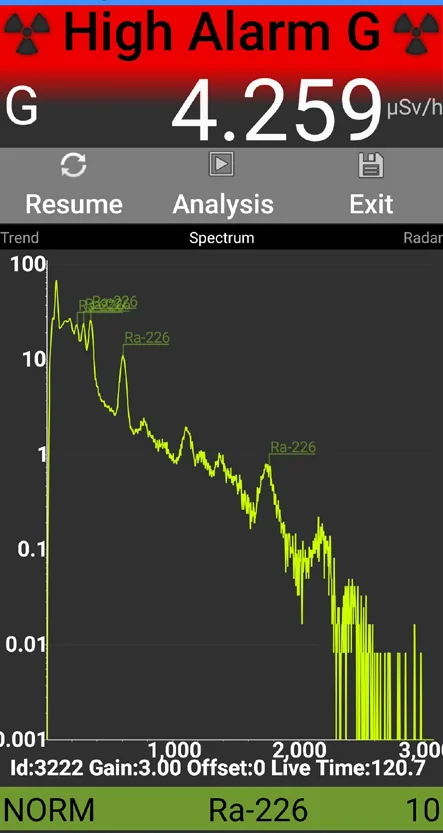
Spectrum screen · for advanced / expert users
Case 01
Heavily shielded isotopes
Case 02
Unbalanced mixtures of nuclides
Case 03
SNM masked by medicals or NORM
1024Channel fast digital MCA
>100 000 cpsThroughput
7 / 80Libraries / nuclides
8Nuclides identified simultaneously, up to
- Exceeds the standards. Mirion states that detection and identification performance exceeds ANSI N42-34, IEC62327 and IAEA NSS 1.
- Single, bare or shielded, and mixed isotopes. Special Nuclear Material (SNM) masked by medicals or Naturally Occurring Radioactive Material (NORM) is called out on the device.
- Sourceless LED stabilization. Works in contaminated environment and with fast temperature changes.
- Spectrum acquisition auto on alarm, manual or periodic, with an energy compensated GM tube for high gamma dose rate.
Remote display & start
Start the count from a safer spot
Connect to the SPIR-Ace with a hotspot or Wi-Fi connection and enable acquisition from a safe or more accessible location, to minimize the operator being near the measurement location, especially for longer acquisition counts.
- Built for
- High radiation levels
- Hard to reach locations
- UGV measurements
From the browser
- Start a spectrum countRemote start enables difficult to access or high dose rate measurement campaigns.
- View active updates of the current count rate and spectrum
- Review past measurements and nuclide identifications
Reachback
- Send measurements by emailn42 and CNF files (spectra with efficiency curves and geometry), over Wi-Fi.
- Live data transmissionIncluding to CBRNResponder and SpirVIEW Mobile software; RadResponder/CBRNResponder (spectrum).
- Remote supervisionWith SpirVIEW or other software using file transfer (FTP or HTTP/SSL).
Quantitative assessment
Field spectrum to activity, in a single step
The direct compatibility with Genie (CNF), ISOCS efficiency characterization and onboard geometry selection enables efficient quantitative assessment. When an efficiency is loaded into the unit, it is immediately associated with a count, so activity is calculated in a single step in Genie software.
01
Factory calibration
Calibrated out of the box
Generic detector characterizations, and each unit is calibrated for energy and FWHM, so exporting to Genie software is seamless and reliable. A fast, automated calibration tuning function lets a simple check source reset the effective energy range if long-term gain shifts are observed.
02
Onboard geometry
Pick the geometry
Generic ISOCS characterization and pre-loaded efficiency calibrations. A loaded efficiency becomes available for selection as a geometry on the device.
03
Count & export
Longer count, CNF out
Acquire spectra for a longer time to improve statistics, then export the CNF file to Genie via USB or email on Wi-Fi.
04
Genie software
Quantify & report
Analyze with your familiar ASFs in Genie software for full quantification and nuclide analysis reporting, or reachback to an expertise center by email.
15%–25%Accuracy of the generic ISOCS efficiency characterization of the SPIR-Ace detector. Combined with S573C ISOCS Calibration software, users can create additional custom geometries for most in situ applications.
NRC RG 1.21Efficiency calibrations can be created with ISOCS software and the 3-dimensional Geometry Composer. The ISOCS process is widely accepted and compliant with 2009 NRC Regulatory Guide 1.21.
Genie on requestGenie basic software (to calculate activities from a computer) is one of the bundle options. Ask us about it when you request a quote.
Configurations
NaI as listed. More on request.
The SPIR-Ace is available with a NaI detector for more efficient detection, search and localization, or with LaBr3 for the better resolution needed with complex spectra. Optional neutron and alpha/beta contamination detection cover the remaining hazards and threats.
This listing
SKU NOM006100
NaI(Tl) detector model
A NaI detector for more efficient detection, search, and localization, alongside an energy compensated GM tube for high gamma dose rate.
- Crystal
- dia 35 mm x 51 mm (1.4 in. dia x 2 in.)
- Gamma energy
- 25 keV to 3 MeV
- Dose rate
- 0.001 μSv/h to 100 mSv/h (0.1 μR/hr to 10 R/hr)
- Operating
- -20 °C to +55 °C (-4 °F to +131 °F)
Other configurations · available on request
Detector option
LaBr3(Ce) version
For better resolution needed with complex spectra.
dia 25.4 mm x 34 mm (1 in. dia x 1.34 in.)
-20 °C to +50 °C (-4 °F to +122 °F)
-20 °C to +50 °C (-4 °F to +122 °F)
Optional, integrated
Neutron detector
Moderated 6LiZnS:Ag scintillator.
0.025 eV to 15 MeV (neutron)
Optional, external
GMP-25™ probe
External alpha/beta contamination probe.
Bundles
Kits
- Genie basic software
- NaI+Neutron variant in rugged case
- NaI+Neutron variant in rugged case + GMP-25 contamination probe
Included accessories
- Transportation and storage case
- USB AC power adapter
- Micro USB cable
- Hand strap
- Earphones
Specifications
Technical specifications
Where the NaI and LaBr3 versions differ, both are shown; this listing is the NaI model.
| Detectors | |
|---|---|
| NaI(Tl) version | dia 35 mm x 51 mm (1.4 in. dia x 2 in.) · this listing |
| LaBr3 (Ce) version | dia 25.4 mm x 34 mm (1 in. dia x 1.34 in.) · on request |
| High dose rate | Energy compensated GM tube for high gamma dose rate |
| Options |
|
| Ranges | |
| Energy range | 25 keV to 3 MeV (gamma) 0.025 eV to 15 MeV (neutron, with the optional neutron detector) |
| Gamma dose rate range | 0.001 μSv/h to 100 mSv/h (0.1 μR/hr to 10 R/hr) |
| Identification | |
|---|---|
| MCA | Fast digital MCA, 1024 channels, throughput >100 000 cps |
| Isotopes | Single, bare or shielded, and mixed isotopes |
| Libraries | Seven libraries containing 80 nuclides |
| Simultaneous | Identifies up to eight nuclides simultaneously |
| Speed | Identifies the radionuclides in 5 to 15 seconds at a dose rate of 0.5 µSv/h (50 µR/h) |
| Performance | Detection and identification performance exceeds ANSI N42-34, IEC62327 and IAEA NSS 1 |
| Spectrum acquisition | Auto on alarm, manual, periodic |
| Compliance | |
| Standards | ANSI N42.34 · IEC62327 · CE |
| Physical | |
|---|---|
| Dimensions | 206 x 153 x 57 mm (8.1 x 6.2 x 2.2 in.) |
| Weight | 1.45 kg (about 3.2 lb) maximum, NaI and LiZnS detectors |
| Environmental | |
| Operating temperature | NaI: -20 °C to +55 °C (-4 °F to +131 °F) LaBr3: -20 °C to +50 °C (-4 °F to +122 °F) |
| Humidity | 93% relative humidity at 40 °C |
| Water and dust | IP65 |
| Power | |
| Battery | Li-ion rechargeable, built-in charger, replaceable |
| Battery life | 8.5 hours (up to 15 hours with screen off most of the time) |
| Charge time | 5 hours (device turned off) with regular 2.1 A/5 V USB adapter |
| Display & controls | |
|---|---|
| Display | 4.3 in. color touch screen LCD readable in all lighting conditions |
| Update | Fast display update (every 0.25 s) |
| Alarm indicators | LEDs, vibrator and sound |
| Controls | Touch screen and two buttons for gloves/Personal Protective Equipment (PPE) operation |
| Audio | Earphone jack |
| Languages | English, French, Korean, Chinese, Japanese, Russian (additional languages on request) |
| Connectivity | |
| Wi-Fi |
|
| Remote control | Remote display and control via a web enabled wireless device (Wi-Fi) |
| Location | GNSS receiver (global GPS); records the location of all measurements/events (mapping) |
| Wired | Micro USB connection |
| In the box | |
| Included accessories | Transportation and storage case · USB AC power adapter · Micro USB cable/Hand strap/Earphones |
Resources
Downloads & support
Datasheet · PDF
SPIR-Ace datasheet
Features, detect / locate / identify, quantitative assessment with Genie, and full specifications.
FarrWest serviceRepair Depot
OEM-certified service and support on every product we deliver. When a repair or calibration falls outside our in-house scope, we coordinate directly with the third-party manufacturer and manage the logistics end to end.
Configuration helpNaI, LaBr3 or neutron?
Tell us what you need to detect and where. We'll come back with the SPIR-Ace configuration, options and bundle that fit the job.
FAQ
Common questions
Which SPIR-Ace configuration is this listing?
This listing (SKU NOM006100) is the NaI(Tl) detector model, dia 35 mm x 51 mm (1.4 in. dia x 2 in.). The LaBr3(Ce) version, the optional integrated neutron detector, the optional GMP-25™ alpha/beta contamination probe and the bundles are other configurations, available on request.
NaI or LaBr3: what's the difference?
NaI is for more efficient detection, search, and localization; LaBr3 gives the better resolution needed with complex spectra. Operating temperature also differs: NaI -20 °C to +55 °C (-4 °F to +131 °F), LaBr3 -20 °C to +50 °C (-4 °F to +122 °F).
How fast does it identify a radionuclide?
It identifies the radionuclides in 5 to 15 seconds at a dose rate of 0.5 µSv/h (50 µR/h), and identifies up to eight nuclides simultaneously from seven libraries containing 80 nuclides.
Can I run it without standing next to it?
Yes. The SPIR-Ace provides an IP address to use on any web browser from a device connected to the same network. If there is no network, it can act as a hotspot and other devices connect using the QR code shown on its screen. From the browser you can start a spectrum count, view active updates of the current count rate and spectrum, and review past measurements and nuclide identifications.
How does it work with Genie software?
Each unit is calibrated for energy and FWHM and carries generic ISOCS characterization with pre-loaded efficiency calibrations. Export the CNF file to Genie via USB or email on Wi-Fi and analyze it for full quantification and nuclide analysis reporting. Genie basic software is a bundle option; ask us about it when you request a quote.
What is the battery life?
8.5 hours (up to 15 hours with screen off most of the time). The Li-ion battery is rechargeable and replaceable, with a built-in charger; charge time is 5 hours (device turned off) with a regular 2.1 A/5 V USB adapter.
How much does it weigh?
1.45 kg (about 3.2 lb) maximum, with NaI and LiZnS detectors. Dimensions are 206 x 153 x 57 mm (8.1 x 6.2 x 2.2 in.).
What comes in the box?
Transportation and storage case, USB AC power adapter, and Micro USB cable/Hand strap/Earphones.
Why FarrWest
Buying from FarrWest
Cooperative contracts
BuyBoard & PCA vendor
FarrWest is a pre-approved vendor on BuyBoard and Purchasing Cooperative of America (PCA). Government agencies can buy on competitively-bid cooperative contracts, with no lengthy RFP.
ServiceService after the sale
OEM-certified service and support on every product we deliver: functional checks and certified calibration on the manufacturer’s required cycle, back in service in 48–72 hours typical.
Since 2004Woman-owned, HUB-certified
Serving Hazmat, Fire, Police, EMS, and Specialty Vehicle operations nationwide since 2004, with expert support, training, and service after the sale.
Next step
Detect, locate, identify, quantify
Tell us your mission and the threats you need to cover. We'll confirm the right SPIR-Ace configuration and get back to you with availability and next steps.