

Teledyne FLIR / Radionuclide identification device (RID)
FLIR identiFINDER R400
Handheld Spectroscopic Radiation Detection & Identification
Operators use the handheld R400 to detect, quickly locate, measure, and identify the source of radioactive material. Teledyne FLIR describes it as the most widely deployed handheld radiation detection and identification product in the world.
Over 20,000Deployed globally
≤3.2 lbsWeight (≤1.5 kg)
<2 minsFrom cold start
ANSI N42.34Nuclide identification
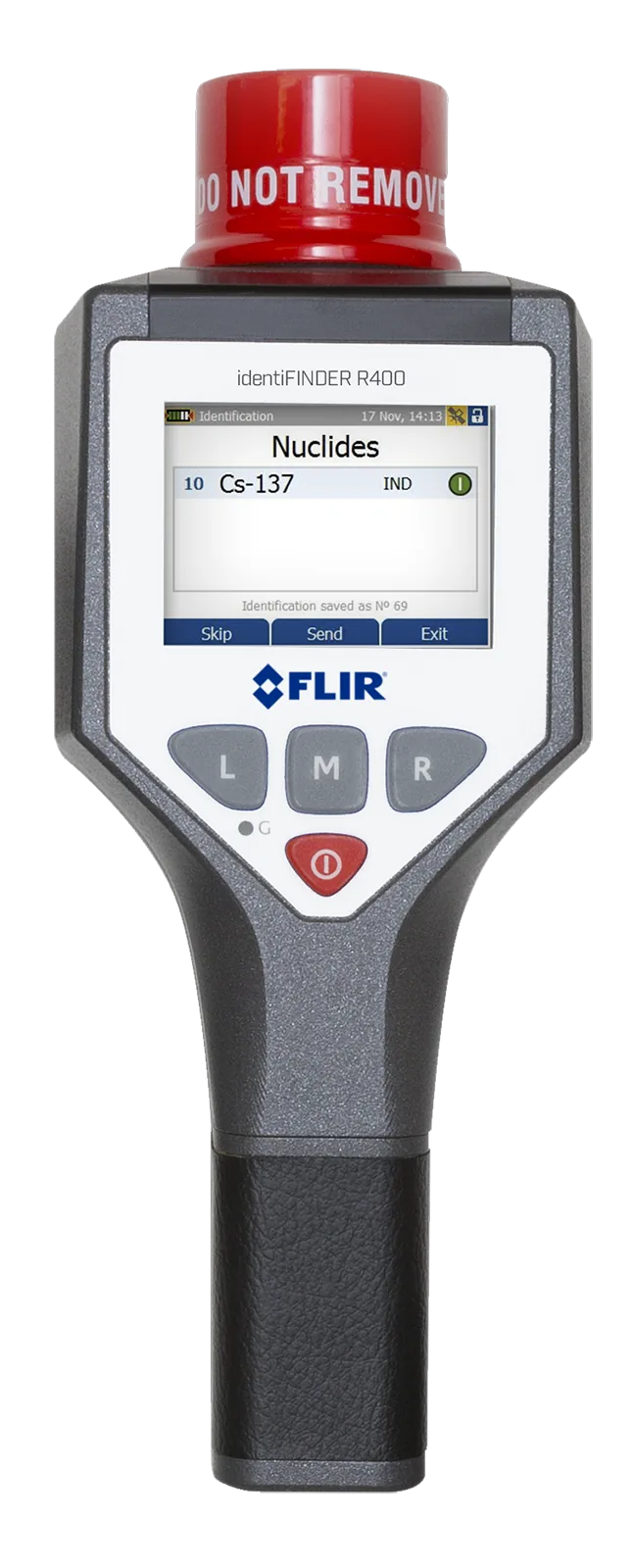

The ideal balance of size and weight for a wide variety of monitoring scenarios.
- All-purpose surveying
- Emergency response
- Environmental monitoring
The proven platform
Field-proven, tried and true
The R400 is a handheld RID in the identiFINDER R-series. Teledyne FLIR puts it at over 20,000 devices deployed globally and calls it the most trusted RID in the world. It shares a common operating interface with other identiFINDER R-series products, which Teledyne FLIR says reduces training time and costs.

- 01
Over 20,000 deployed globally
Teledyne FLIR’s summary: “Over 20,000 deployed globally for tough, tried-and-true performance.”
- 02
One interface across agencies
The common operating interface reduces training time and costs, while increasing operator confidence and inter-operability between agencies.
- 03
Sized for stressful work
Teledyne FLIR states that at half the size and weight of competitive RIDs, the R400 helps operators feel comfortable using the instrument even in the most hazardous and stressful environments.
- 04
Rugged and mission-ready
Built for fast front-line detection and response, in an aluminum housing weighing ≤3.2 lbs (≤1.5 kg).
Field-proven, per Teledyne FLIR
identiFINDER R400
The handheld RID on this page.
- Over 20,000 deployed globally
- NaI or LaBr detectors
- Gamma only or gamma and neutron models
- Common operating interface reduces training burden
Next generation
identiFINDER R425
“The identiFINDER R425, the next generation of the most deployed radionuclide identification device (RID)…”
“Same tried and trusted interface as the R400. Pick it up and go.”
Teledyne FLIR
Workflow
Detect. Locate. Measure. Identify.
One handheld covers the whole sequence, from the first alert to a nuclide identification. The scintillator covers dose rates up to 500 μSv/h, and a back-up Geiger-Müller tube provides detection capability even in high dose rate environments.
-
Step 01
Detect
Rapid visible, audible, and tactile alerts that expedite response measures.
Energy range (gamma)20 keV - 3 MeV -
Step 02
Locate
Quickly and efficiently close in on the source of radioactive material.
Scintillator dose rate range0 nSv/h - 500 μSv/h (0 nrem/h - 50 mrem/h) -
Step 03
Measure
Back-up gamma detector provides detection capability, even in high dose rate environments.
Geiger-Müller dose rate range100 μSv/h - 1 Sv/h (10 mrem/h - 100 rem/h) -
Step 04
Identify
Identifies ANSI N42.34 library, with high resolution and low false alarms.
Sampling & analysisFrom a few seconds to minutes

Identification screen
Identification
Identification you can read
Nuclide identification follows ANSI N42.34. The R400 stores up to 600,000 spectra in 2GB internal memory, and the large, color display eases data interpretation.
1024 channelsGamma spectrum; 3 MeV
600,000 spectra2GB internal memory
±30 %Dose rate accuracy (Cs-137)
0 nSv - 1 SvDose range (0 nrem - 100 rem)
Configurations
Choose the crystal, the radiation, the housing
The R400 comes in ten product variants. Teledyne FLIR describes NaI or LaBr detectors for custom sensitivity and resolution, gamma-only or gamma and neutron models, and an underwater model. Two variants use a tungsten-shielded NaI detector.
Choice 01
Gamma detector
The scintillator used for spectroscopy and identification.
NaIGamma (NaI) · 1.4 x 2.0 in (35 x 51 mm)
- Typical resolution
- ≤8%
- Stabilization (35 x 51 mm)
- Calibration source
A tungsten-shielded NaI detector, 0.9 x 0.8 in (23 x 21 mm), is also listed; two of the ten variants (T1, T2) use it.
or
LaBr3Gamma (LaBr3) · 1.2 x 1.2 in (30 x 30 mm)
- Typical resolution
- 4.5%
- Stabilization
- LED
Choice 02
Radiation
Available in gamma only or gamma and neutron models.
Gamma onlyScintillator plus Geiger-Müller tube
- Energy range
- 20 keV - 3 MeV
- High dose rate
- Geiger-Müller tube
or
Gamma + neutronAdds a He-3 tube · 0.6 x 2.1 in (15 x 54 mm)
- Neutron sensitivity
- 2.6 cps/nv; ±20 %
Choice 03
Housing
Aluminum housing, rated according to IEC 60529.
StandardIP53 according to IEC 60529
- Operating humidity
- 10 to 80%
- Communication
- USB
or
UnderwaterIP68 according to IEC 60529 · 10 m; 8 h
- Operating humidity
- 100%
- Communication
- LEMO Series K socket
Tell us the detector, radiation type and housing you need when you request a quote, and we will confirm the details with you.
Ask about configurationsAlerts & communications
Alerts that move the decision forward
Like other identiFINDER R-series products, the R400 contains on-board Bluetooth, web server, and GPS technologies, so important tactical information is easy to transfer.

Visible, audible, tactile
Rapid visible, audible, and tactile alerts expedite response measures.
Large color display
A transflective color LCD eases data interpretation.
GPS, webserver, Bluetooth
On-board GPS, webserver, and Bluetooth capabilities, with onboard webserver software.
Fast two-minute startup
<2 mins from cold start. Either rechargeable NiMH or 4x AA pack (supplied), with ≥8h operational battery life.
Short to train
Training requirements: <10 mins for operator; 1 day for advanced user. The common operating interface reduces training burden.
Specifications
Key specifications
Where a value differs between configurations, the NaI, LaBr, neutron or underwater version is named.
| Detectors | |
|---|---|
| Technology | Radionuclide identification device (RID) |
| Gamma (NaI) | 1.4 x 2.0 in (35 x 51 mm) |
| Gamma (NaI), tungsten shielded | 0.9 x 0.8 in (23 x 21 mm) - Tungsten shielded |
| Gamma (LaBr3) | 1.2 x 1.2 in (30 x 30 mm) |
| Neutrons (He-3) | 0.6 x 2.1 in (15 x 54 mm) · neutron models |
| Gamma (high dose rate) | Geiger-Müller tube |
| Performance | |
| Energy range (gamma) | 20 keV - 3 MeV |
| Gamma spectrum | 1024 channels; 3 MeV |
| Typical resolution |
|
| Stabilization |
|
| Neutron sensitivity | 2.6 cps/nv; ±20 % · neutron models |
| Dose | |
|---|---|
| Dose rate / accuracy (Cs-137) | 0 nSv/h - 500.00 mSv/h (0 nrem/h - 50.0 rem/h); ±30 % |
| Scintillator dose rate range | 0 nSv/h - 500 μSv/h (0 nrem/h - 50 mrem/h) |
| Geiger-Müller dose rate range | 100 μSv/h - 1 Sv/h (10 mrem/h - 100 rem/h) |
| Dose range | 0 nSv - 1 Sv (0 nrem - 100 rem) |
| Identification | |
| Nuclide identification | According to ANSI N42.34 |
| Sampling & analysis | From a few seconds to minutes |
| Sample introduction | Absorption of EM gamma emissions |
| Threats | Detects neutron or gamma radiation emitted from natural occurrences in the environment, special nuclear material, industrial, or medical material |
| Display & communication | |
|---|---|
| Display & alerts | Transflective color LCD |
| Communication |
|
| On-board | GPS, webserver, and Bluetooth capabilities |
| Software | Onboard webserver software |
| Data storage | 2GB internal memory; up to 600,000 spectra |
| Operation | |
| Training requirements | <10 mins for operator; 1 day for advanced user |
| Service interval | 5-year factory maintenance |
| Power | |
|---|---|
| Input voltage | 100-240 VAC (wall and car adapters and USB cable supplied) |
| Battery | Either rechargeable NiMH or 4x AA pack (supplied); ≥8h operational battery life; recharge ≤4h when using AC; recharge >4h when using USB |
| Cold start time | <2 mins from cold start |
| Environment | |
| Operating temperature | -4 to 122 °F (-20 to 50 °C) |
| Operating humidity |
|
| Storage temperature | 14 to 95 °F (-10 to 35 °C) |
| Enclosure & protection |
|
| Physical | |
| Dimensions (L x W x H) | ≤3.7 x 10.6 x 3.2 in (9.4 x 26.9 x 8.1 cm) - with battery |
| Weight | ≤3.2 lbs (≤1.5 kg) |
This product is subject to United States export regulations and may require US authorization prior to export, reexport, or transfer to non-US persons or parties.
Resources
Downloads & service
Datasheet · PDF
identiFINDER R400 datasheet
Handheld Spectroscopic Radiation Detection & Identification.
Next generationidentiFINDER R425
Billed by Teledyne FLIR as the next generation of the most deployed RID, with the same tried and trusted interface as the R400.
ServiceRepair Depot
OEM-certified service and support on every product we deliver. When a repair or calibration falls outside our in-house scope, we coordinate directly with the third-party manufacturer and manage the logistics end to end.
FAQ
Common questions
How does the R400 relate to the identiFINDER R425?
The R400 is available from FarrWest on request. Teledyne FLIR bills the R425 as “the next generation of the most deployed radionuclide identification device (RID)” with the “Same tried and trusted interface as the R400.” See the identiFINDER R425 page to compare.
Should I choose a NaI or a LaBr detector?
Teledyne FLIR states that NaI or LaBr detectors provide custom solutions for sensitivity and resolution. Typical resolution is ≤8% for NaI and 4.5% for LaBr3. The 1.4 x 2.0 in NaI detector is stabilized with a calibration source and the LaBr3 detector with an LED. Request a quote and tell us how you plan to use it.
Is the R400 waterproof?
Only the underwater models. They carry a protection rating of IP68 according to IEC 60529 (10 m; 8 h) and an operating humidity of 100%. Standard models are rated IP53 according to IEC 60529, with an operating humidity of 10 to 80%.
Does it detect neutrons?
The R400 is available in gamma only or gamma and neutron models. Neutron models add a He-3 tube, 0.6 x 2.1 in (15 x 54 mm), with a neutron sensitivity of 2.6 cps/nv; ±20 %.
How long does it take to train an operator?
Teledyne FLIR lists training requirements of <10 mins for operator; 1 day for advanced user. The common operating interface it shares with other identiFINDER R-series products reduces training time and costs.
What powers it, and how long does it run?
Either rechargeable NiMH or 4x AA pack (supplied), with ≥8h operational battery life. Recharge takes ≤4h when using AC and >4h when using USB. Wall and car adapters and a USB cable are supplied, and it starts in <2 mins from cold start.
What service does it need, and can FarrWest help?
Teledyne FLIR specifies a service interval of 5-year factory maintenance. The FarrWest Repair Depot provides OEM-certified service and support on every product we deliver. When a repair or calibration falls outside our in-house scope, we coordinate directly with the third-party manufacturer and manage the logistics end to end.
Are there export restrictions?
Yes. This product is subject to United States export regulations and may require US authorization prior to export, reexport, or transfer to non-US persons or parties.
Why FarrWest
Buying from FarrWest
Cooperative contracts
BuyBoard & PCA vendor
FarrWest is a pre-approved vendor on BuyBoard and Purchasing Cooperative of America (PCA). Government agencies can buy on competitively-bid cooperative contracts, with no lengthy RFP.
ServiceService after the sale
OEM-certified service and support on every product we deliver: functional checks and certified calibration on the manufacturer’s required cycle, back in service in 48–72 hours typical.
Since 2004Woman-owned, HUB-certified
Serving Hazmat, Fire, Police, EMS, and Specialty Vehicle operations nationwide since 2004, with expert support, training, and service after the sale.
Next step
Put a proven RID in your team’s hands
Tell us the detector, radiation type and housing you need, and how you will use it. We will come back with configuration details and a quote.