

Sensit Technologies · Gas leak detection
Sensit Gold G3
Multi gas detector · Locate above & below ground leaks
The combustible sensor rides at the tip of the flexible gooseneck, so the sample reaches it the moment the pump draws it in. A metal oxide semiconductor sensor reads methane as low as 1 ppm and up to 100% LEL, the display switches between PPM, %LEL and %VOL on its own (if enabled), and the tick tone lets you chase a leak by ear. Add oxygen and toxic sensors, or a thermal conductivity sensor for readings up to 100% volume.
Intrinsically safe for Class I Div. 1, Groups C and D, T4 (UL 913)
1 ppmMethane, low end of the semiconductor sensor
>12 hContinuous on the rechargeable battery
5Gas capability with all optional sensors
IP64Ingress protection, rubberized housing
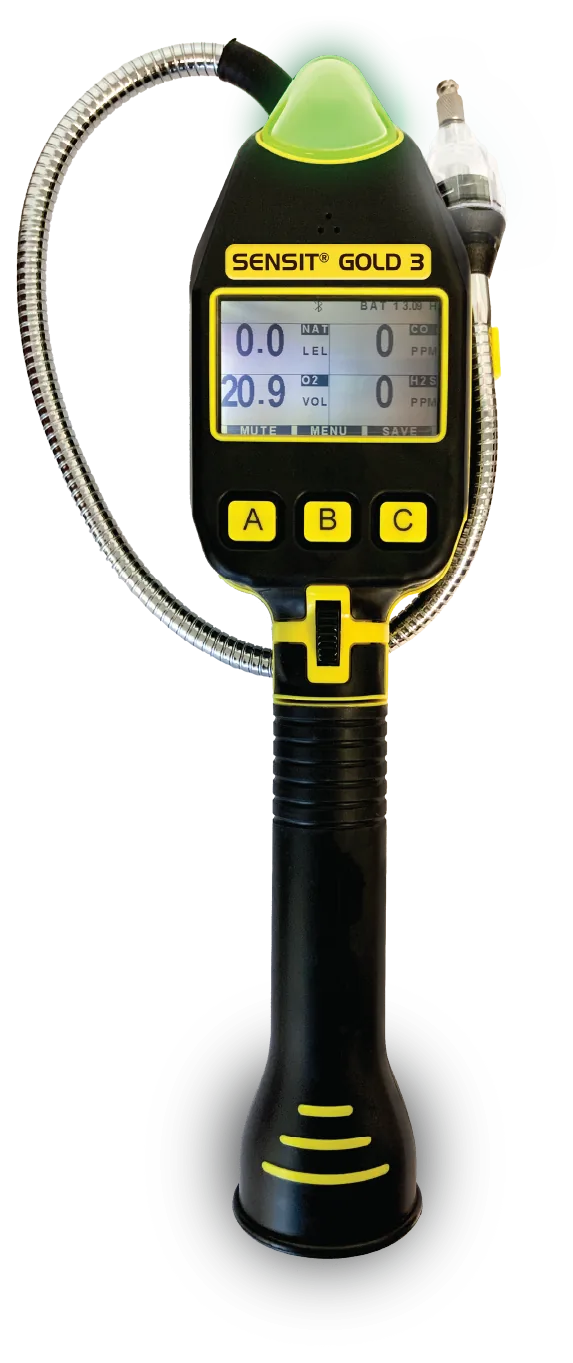
Hardware tour
Ten labels, one hand
Everything the operator touches sits on a single handheld: the sensor at the end of the wand, the alarms and display in the head, the tick wheel under your thumb and the battery in the grip. Here is what each labelled part does.

ALARM LEDs
The dome reads at a glance: solid green ready, solid amber for the combustible LOW or HIGH alarm, solid red for HAZ 1 and 2, blinking red for any alarm, sensor failure or flow blocked.
SENSOR CAP with WATER/DIRT FILTER
A hydrophobic dirt and water filter protects the pump and internals, backed by an internal micron filter. If the sampling system is compromised the display shows a flow blocked message. Running without the cap can damage the instrument and void the warranty.
LEL/PPM SENSOR
The metal oxide semiconductor sensor sits at the end of the gooseneck. There is essentially no travel time for the sample: the first thing it hits after the pump is the sensor, for near instantaneous reaction to gas.
SOUNDER
Carries the audible alarms for hazardous conditions. The tick is an audible tone that gets faster as the gas concentration increases.
TFT LCD
A 2.7" TFT LCD that is always backlit, so it is easy to read. Combustible readings move between PPM, %LEL and %VOL without operator input.
3 BUTTON OPERATION
A power, mute, Smart-Cal and escape. B the menu for tick, bar hole, leak search, purge and other special modes. C save data, autozero, scroll and flashlight.
FLEXIBLE GOOSENECK
Puts the sensor where the gas is. LEDs on the sensor circuit board turn the wand into a flashlight: press and hold C for 1-2 seconds in dark areas, and switch it off whenever you like.
TICK WHEEL
The thumbwheel on the front of the handle adjusts the tick rate very gradually. The B button resets it to a baseline tick instantly.
OVER MOLDED, RUBBERIZED HOUSING
A rubberized housing with an IP64 ingress protection rating, at 2.3lbs (1.0kg).
BATTERY COMPARTMENT
The standard rechargeable battery pack lives in the handle, secured with a captured Phillips-head screw. Charge it in the instrument or on its own in the included charging station.
Leak investigation
From first reading to logged result
The B button opens the special modes. Here is how the modes line up on a combustible gas leak call. Some are standard, some are optional features, and a few need the optional TC sensor, so the exact set depends on how your unit is configured when it is ordered.

-
00Every start
Start clean
Always start and zero the instrument in a gas free environment. Then block the inlet at the end of the gooseneck: within a few seconds FLOW BLOCKED should show, proving the sensor cap and internal tubing are sound.
- Startup
- Less than 45 seconds, up to a maximum of 5 minutes depending on sensor outputs
- On screen
- Calibration next due date for every installed sensor
-
01Optional feature
Leak Search
For leak investigations and surveys that need the PPM scale with a low PPM alarm. The instrument reads in 1ppm increments up to 5000ppm, then auto ranges to %LEL and %VOL. Attach a drag tube assembly or telescoping survey probe.
- Alarm
- 50ppm preset (factory adjustable)
- Pump
- High speed, 0.4 – 0.5 L/min
-
02Standard
Tick
A ticking tone that gets faster as concentration increases helps pinpoint small combustible leaks, so you can follow the tone instead of watching the display. Ease the rate with the thumbwheel, or press B to snap back to baseline.
- Models
- Default feature, available on all models
- Controls
- Tick wheel + B button
-
03Standard · needs TC
Bar Hole Test
Below grade leak investigation. A timed test on the high-speed pump, so each hole is done faster than with previous generation instruments. A bar hole probe is required when sampling below grade in a hole.
- Timer
- 30 sec. by default
- Requires
- TC sensor (%VOL sensor)
-
04With TC sensor
Read the gas
With the optional TC sensor, two non-standard readings help interpret what you found: NSR (non-standard response) means the gas is likely not combustible; NSC (non-standard combustible) means it is likely combustible.
- Above LEL
- Switches to %VOL at 100%LEL (5.0%VOL by default)
-
05Software sold separately
Log & download
Each bar hole test is logged on its own with results, date and time, plus GPS coordinates when the optional GPS module is installed. Retrieve the logs wirelessly over Bluetooth with SMART-LINK 360 software.
- Link
- Bluetooth to SMART-LINK 360
- Location
- Optional GPS module
Other jobs on the B button
Further test modes, for line work, flues and overhead areas.
Standard · needs TC
Purge Test
For purging lines into service with fuel. It is not intended for purging lines out of service.
Requires a purge probe, to prevent over-pressurization and damage to the instrument
Optional feature
Inert Mode
For purging lines out of service with inert gas.
Requires an oxygen (O2) sensor and a dilution tube assembly
Optional feature
CO Test
A timed test, 180 sec. by default. When analysing flue gas, or testing appliance vents and flues, a hot air probe must be used.
Requires a carbon monoxide (CO) sensor
Optional feature
Peak Mode
Holds peak readings on the work display alongside the real-time readings for each installed sensor, for example when monitoring overhead or confined space areas.
Keeps a peak for each installed sensor
One reading, three scales
PPM to %LEL to %VOL, hands off
All gas readings switch automatically between PPM, %LEL and %VOL (if enabled), with no input from the operator. The lamp on top tracks the same climb. Shown here for natural gas (methane).
PPMIf enabled
Starts at 0ppm. *Switch point is 2,000ppm by default; 5,000ppm, 10,000ppm or 50,000ppm are options.
%LELDefault start · 0.0%LEL
%VOLWith TC sensor
Above 100%LEL the reading moves to %VOL, up to 100%VOL, when the optional TC sensor is fitted. 100%LEL equals 5.0%VOL methane by default (factory adjustable between 4.0% and 5.0%).

What the dome is telling you
- Solid greenReady. No current alarm condition or failure.
- Blinking greenLow battery.
- Solid amber / yellowLOW or HIGH combustible gas alarm, depending on configuration. Default setpoint 5.0%LEL.
- Solid redHAZ 1 and 2 combustible conditions: HAZ1 at 10%LEL, HAZ2 at 25%LEL.
- Blinking redAny alarm condition, sensor failure or flow blocked.
- Solid blueBusy: user in menus, calibration, or Smart-Link 360 viewing logs.
Methane gas conversion
| % Gas | % LEL | PPM |
|---|---|---|
| 0.1% | 2.0% | 1,000 |
| 0.5% | 10.0% | 5,000 |
| 1.0% | 20.0% | 10,000 |
| 1.5% | 30.0% | 15,000 |
| 2.0% | 40.0% | 20,000 |
| 2.5% | 50.0% | 25,000 |
| 3.0% | 60.0% | 30,000 |
| 3.5% | 70.0% | 35,000 |
| 4.0% | 80.0% | 40,000 |
| 4.5% | 90.0% | 45,000 |
| 5.0% | 100.0% | 50,000 |
At the low end: 0.1% LEL = 50 ppm, 0.2% LEL = 100 ppm, 1.0% LEL = 500 ppm.
Sensors
Five gases, three slots
Every unit carries the semiconductor combustible sensor. On top of that, up to three electrochemical slots take oxygen and toxic sensors. All four gases are possible, making a 5-gas detector, because CO and H2S then share a combination sensor.
Combustible
At the end of the gooseneck, plus an optional thermal conductivity sensor for high concentrations.
LEL / PPMEvery unit
Metal oxide semiconductor
Highly sensitive and uniquely designed. Measures as low as 1PPM methane, up to 100%LEL (5.0%VOL).
- LEL range
- 0-100% LEL
- LEL resolution
- Variable: 0.1 % - 2.0% Increments
- LEL accuracy
- ±10% or 1%LEL*
- PPM range
- 0 - 50,000ppm
- PPM resolution
- 1ppm or 10ppm
- PPM accuracy
- ±10% or 500ppm*
% GasOptional TC sensor
Thermal conductivity
Extends the reading above 100%LEL, up to 100%VOL, measuring high concentrations quickly and accurately. Unlocks the bar hole and purge tests and the NSR / NSC readings.
- Range
- 5-100% Methane
- Resolution
- 0.1 %
- Accuracy
- ±5%
Electrochemical · optional · up to 3 slots
Smart sensors: each is paired with a circuit board that monitors the sensor output and records its most recent calibration data.
O2Optional
Oxygen
- Range
- 0-25%
- Resolution
- 0.1 %
- Accuracy
- ±0.2% or 10%*
COOptional
Carbon monoxide
- Range
- 0-2,000ppm
- Resolution
- 1ppm
- Accuracy
- ±5ppm or 5%*
H2SOptional
Hydrogen sulfide
- Range
- 0-100ppm
- Resolution
- 1ppm or 0.1ppm
- Accuracy
- ±2ppm or 5%*
HCNOptional
Hydrogen cyanide
- Range
- 0-30ppm
- Resolution
- 1ppm or 0.1ppm
- Accuracy
- ±1ppm or 5%*
*whichever is greater.
Power, calibration & records
Dock it, check it, prove it
A charging station that mounts where the truck or shop needs it, calibration that can run on a station or by hand, and a calibration record that lives inside the instrument.
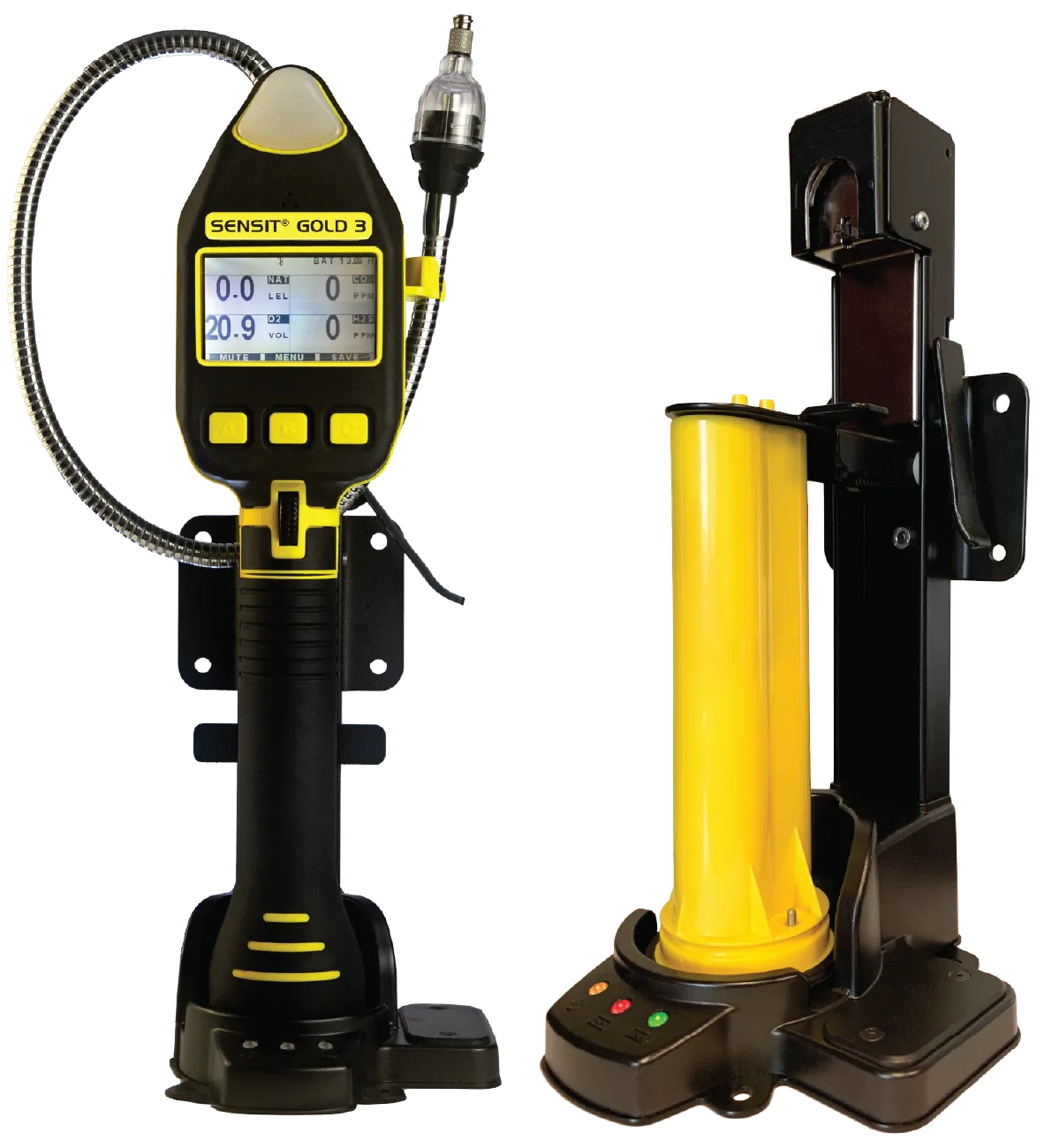
Instrument in its charging base · battery pack charging on its own
- 01
Rechargeable, standard
The battery pack in the handle runs more than 12 hours continuous and charges between 32°F and 104°F (0°C to 40°C). Charge it in the instrument or removed, with the included charging station/dock.
- 02
Mount the dock where you need it
Semi-permanently on a table or wall, in a vehicle, or free standing. Its lamp shows orange/yellow for power, red while charging, blinking red when the battery is outside its charging temperature range, and green when full.
- 03
SMART-CAL 360 compatible
Compatibility with the SMART-CAL 360 station is a standard feature. The calibration/bump test station completely automates calibration and bump tests, and syncs the instrument clock to the station. Or attach gas bottles and use the manual calibration and bump test menus, or the semi-automated AUTOCAL process.
- 04
Calibration history on board
Every calibration, successful or not, is stored in a log on the internal memory, and the next due date for each sensor shows at startup. A bump test needs each sensor to reach at least 80% of the calibration gas value; it does not replace a calibration or update the due date.
- 05
Bump test gases
2.5%VOL methane (CH4) in air for the LEL sensor; 100ppm CO in air; 25ppm H2S in air; 10ppm HCN in nitrogen.
Specifications
Key specifications
Optional sensors and modes are configured per order.
| Physical | |
|---|---|
| Size | L-13 x W-3 x D-3.2 in (330 x 76 x 81mm) |
| Weight | 2.3lbs (1.0kg) |
| Housing | Over molded, rubberized housing |
| Ingress protection | IP64 |
| Operating temp | -4 to 122° F (-20 to 50° C) |
| Storage temp | -4 to 140° F (-20 to 60° C) |
| Interface | |
| Display | 2.7" TFT LCD, always backlit |
| Controls |
|
| Tick adjustment | Thumbwheel on the front of the handle; B button resets to baseline tick rate |
| Alarms | Audible and visual |
| Flashlight | Individual LEDs on the sensor circuit board in the wand; can be enabled or disabled |
| Startup | Less than 45 seconds; up to a maximum of 5 minutes depending on the outputs of the sensors |
| Sampling | |
| Pump | Two speeds: high (0.4 – 0.5 L/MIN) in BARHOLE or LEAK SEARCH mode; low (0.3 L/min) in the work display or any other test mode |
| Filtration | Hydrophobic dirt and water filter in the sensor cap at the end of the gooseneck, plus an internal micron filter |
| Flow monitoring | Flow blocked message if the sampling system is compromised |
| Combustible | |
|---|---|
| LEL | Semiconductor · Range 0-100% LEL · Resolution Variable: 0.1 % - 2.0% Increments · Accuracy ±10% or 1%LEL* |
| PPM | Semiconductor · Range 0 - 50,000ppm · Resolution 1ppm or 10ppm · Accuracy ±10% or 500ppm* |
| %Gas (optional TC sensor) | Thermal Conductivity · Range 5-100% Methane · Resolution 0.1 % · Accuracy ±5% |
| Gas type | Natural gas (methane); default calibration point 2.5%VOL, can also be set to 2.2%VOL |
| LEL definition | 5.0%VOL methane by default; factory adjustable between 4.0% and 5.0% in 0.1% increments |
| Electrochemical (optional, up to 3 slots) | |
| O2 | Range 0-25% · Resolution 0.1 % · Accuracy ±0.2% or 10%* |
| CO | Range 0-2,000ppm · Resolution 1ppm · Accuracy ±5ppm or 5%* |
| H2S | Range 0-100ppm · Resolution 1ppm or 0.1ppm · Accuracy ±2ppm or 5%* |
| HCN | Range 0-30ppm · Resolution 1ppm or 0.1ppm · Accuracy ±1ppm or 5%* |
| 5-gas configuration | Detection for all 4 is available; the CO and H2S sensors are then a combination sensor |
| Note | *whichever is greater |
| Battery | |
|---|---|
| Battery | Rechargeable battery pack, standard, installed in the handle |
| Battery life | >12hrs Continuous with Rechargeable |
| Charging temperature | 32°F to 104°F (0°C to 40°C) |
| Charging | In the instrument, or removed, with the included charging station/dock; station can be mounted to a table or wall, in a vehicle, or left free standing |
| Data & calibration | |
| Calibration station | Compatible with the SMART-CAL 360 calibration/bump test station (standard feature) |
| Calibration log | Every calibration stored on internal memory, successful and unsuccessful |
| Test logs | Each bar hole test logged with results, date and time, and GPS coordinates (if installed) |
| Software | SMART-LINK 360 software, sold separately: downloads logs via a Bluetooth connection |
| GPS | Optional module adds location information to the data logging system |
| Work display alarm defaults | |
|---|---|
| LEL | 50.0%LEL |
| CO | 35PPM |
| O2 depletion | 19.5%VOL |
| O2 enrichment | 23.5%VOL |
| H2S | 10.0PPM |
| HCN | 4.7PPM |
| UEL (natural gas) | 17.0%VOL |
| Leak search mode | 50 PPM (unless otherwise noted on the setup sheet) |
| LED dome | |
| Solid amber / yellow | LOW or HIGH combustible alarm; default setpoint 5.0%LEL |
| Solid red | HAZ1 triggered at 10%LEL; HAZ2 triggered at 25%LEL |
| Blinking red | Any alarm condition, sensor failure, flowblocked |
| Hazardous locations | Intrinsically safe for use in: Class I Div. 1 Groups C, D; Temp Classification: T4, IP64 |
|---|---|
| Marking | SGS mark, 710183 UL913 |
| Warning | To prevent ignition of flammable or combustible atmosphere, disconnect power before servicing. |
| Warranty | Free from defects in materials and workmanship for a period of two years after purchase (excluding calibration and batteries) |
| Origin | Made in the USA with globally sourced components |
Configure & talk to us
Built to your setup sheet
The G3 can be configured to meet the job. A setup sheet is created at the time of order with every setting you choose, so any instruments ordered later are set up exactly the same way. Many settings sit in the Expert Menu and can be adjusted over the phone if your requirements change.
Sensors
Pick the gas package
The combustible sensor is on every unit. Choose from:
- TC sensor for %VOL, bar hole and purge
- Oxygen (O2)
- Carbon monoxide (CO)
- Hydrogen sulfide (H2S)
- Hydrogen cyanide (HCN)
Modes & options
Turn on what you use
Optional features:
- Leak search mode
- CO test
- Peak, standby and inert modes
- GPS module
Accessories & software
Ask about the extras
Used for specific tests; tell us your work and we will advise:
- Bar hole, purge and hot air probes
- Drag tube assembly, telescoping survey probe
- Dilution tube assembly for inert mode
- SMART-LINK 360 software (sold separately) and the SMART-CAL 360 station
Request a quote
Or call 210.566.1857 to talk through a configuration.
FAQ
Common questions
How low does the Gold G3 read?
The semiconductor sensor measures concentrations as low as 1PPM methane, up to 100%LEL (5.0%VOL). With the PPM option enabled the reading starts at 0ppm; in leak search mode it reads in 1ppm increments up to 5000ppm before auto ranging to %LEL and %VOL.
Which combustible gas is it set up for?
Natural gas (methane). Currently only natural gas (methane) is available as a GAS TYPE option. The default calibration point is 2.5%VOL methane (it can also be set to 2.2%VOL), and the LEL is defined as 5.0%VOL methane by default. The gas type setting changes calibration, display and NSR/NSC handling; it does not limit what gases the LEL sensor will respond to.
Do I need the TC sensor?
Only if you need readings above 100%LEL or the tests that depend on it. The optional thermal conductivity sensor extends the reading up to 100%VOL, and the bar hole test, purge test and NSR / NSC readings all require it.
How many gases can it monitor at once?
Up to five. The combustible sensor is on every unit, and there are up to 3 slots for electrochemical sensors (O2, CO, H2S, HCN). Detection for all 4 is available, in which case the CO and H2S sensors are a combination sensor.
How long does the battery last, and how is it charged?
More than 12 hours continuous on the standard rechargeable battery pack, charging between 32°F and 104°F (0°C to 40°C). The pack lives in the handle and charges in the instrument or removed, using the included charging station/dock.
Is it rated for hazardous locations?
Intrinsically safe for Class I Div. 1, Groups C and D, T4 (UL 913), with an IP64 rating and an SGS mark (710183 UL913).
How is calibration handled?
The G3 is compatible with the SMART-CAL 360 calibration/bump test station, which automates calibration and bump tests. You can also calibrate or bump test manually with gas bottles, or use the semi-automated AUTOCAL process. Every calibration is logged on the instrument and the next due date shows at startup. For functional checks and certified calibration on the manufacturer's required cycle, with every certificate stored against the unit's serial number, see the FarrWest Repair Depot. When a repair or calibration falls outside our in-house scope, we coordinate directly with the manufacturer and manage the logistics end to end.
Can settings be changed after I buy it?
A setup sheet is created at the time of order, so future instruments match. Many settings live in the Expert Menu and can be adjusted over the phone if requirements change. Request a quote and we will answer configuration questions.
What is the warranty?
The SENSIT GOLD 3 is warranted to be free from defects in materials and workmanship for two years after purchase, excluding calibration and batteries.
Why FarrWest
Buying from FarrWest
Cooperative contracts
BuyBoard & PCA vendor
FarrWest is a pre-approved vendor on BuyBoard and Purchasing Cooperative of America (PCA). Government agencies can buy on competitively-bid cooperative contracts, with no lengthy RFP.
ServiceService after the sale
OEM-certified service and support on every product we deliver: functional checks and certified calibration on the manufacturer’s required cycle, back in service in 48–72 hours typical.
Since 2004Woman-owned, HUB-certified
Serving Hazmat, Fire, Police, EMS, and Specialty Vehicle operations nationwide since 2004, with expert support, training, and service after the sale.
Next step
Spec your G3 to the job
Tell us the gases, test modes and accessories your crews use, and we will come back with a configuration and quote.