
04
Look through the window
The laser reads through standard window glass. Keep an angle of attack that is less than 90˚ to your target, ideally between 45˚ and 75˚.


Investigate gas leaks from a safer distance. Point the LZ30's beam at a target and the methane reading comes back immediately, from 0.5 to 30 meters (1.5 to 100 feet), without entering the gas plume. It responds to methane only, measures the distance to the target at the same time, weighs 0.7 lb and runs 6.5 hours on a charge.
Class I, Division 2, Group D hazardous location approval · Temperature class T4 · UL 121201, CSA C22.2 No.213
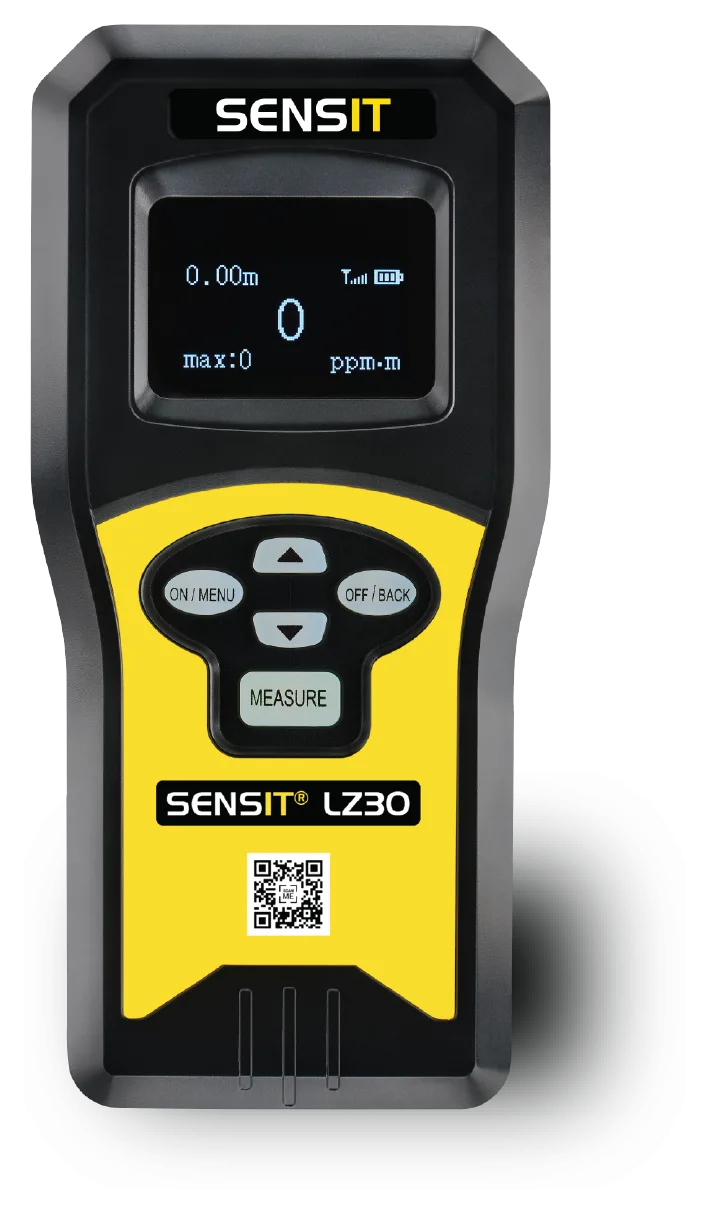
The LZ30 uses open path TDLAS, tunable diode laser absorption spectroscopy. The laser sends a specific wavelength of light through the area, any methane in its path absorbs part of it, and the surface behind reflects it back to the instrument. The higher the methane concentration, the larger the absorption and the higher the reading.
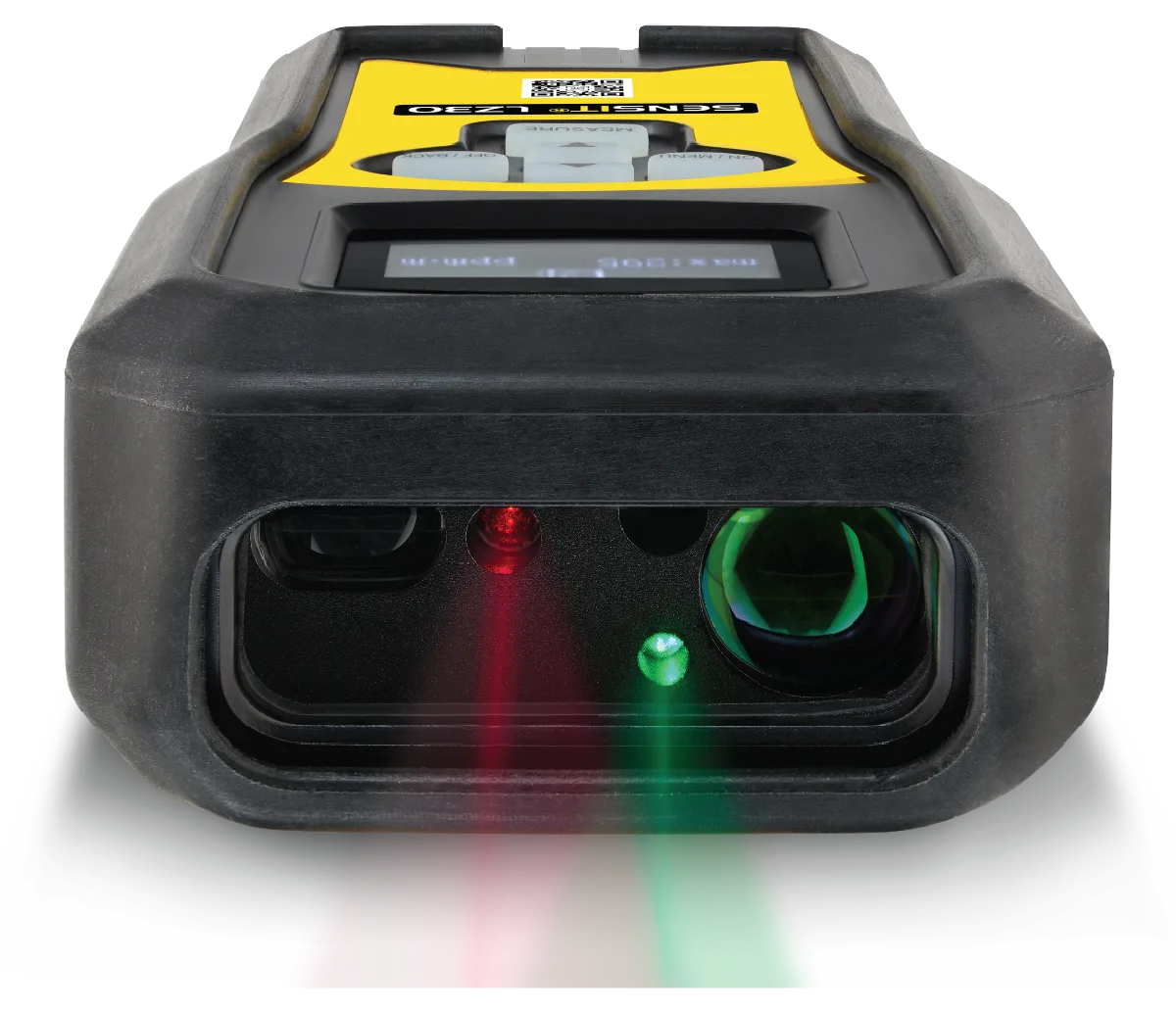
Carries the gas measurement. Open-path TDLAS makes detection instantaneous, accurate and methane specific, up to a distance of 30m (100ft).
Class IIIR · less than 50mWA separate laser sends a pulse to the target in a narrow beam and times its return, so the total distance to the target shows in real time alongside the gas reading.
Class IIIR · less than 5mWA visible spot on the target, so you can see where the invisible detection beam is pointed.
Class IIIR · less than 5mWDesigned to detect methane gas specifically, filtering out other gases: methane and gases containing methane, such as natural gas and naturally occurring sources of methane.
The LZ30 reads in parts per million meter (ppm·m): the average gas concentration over 1 meter, roughly 3.3 feet. The beam totals the methane along its path, so a short, dense plume and a longer, thinner one can give the same number.
That makes point and shoot a great indication tool, and comparing readings helps pinpoint the source of a leak. It cannot be used to quantify a gas leak. To pinpoint and grade the leak, use it alongside a combustible gas detector such as the Sensit Gold G3.
No climbing to elevated areas, no entering fenced-in properties, no walking into the gas plume. The beam is conical: it starts at the front of the instrument and gradually spreads as the distance grows.
Compact enough for hard-to-reach areas where traditional leak detectors are inapplicable. Investigate elevated areas and restricted access locations without climbing up or going in.
Both the distance and the gas reading rely on a surface reflective enough to return the signal to the instrument. Most solid surfaces will work, and the LZ30 has Low Reflection and High Reflection warnings.
The laser can detect through standard window glass, so you can investigate the inside of a building you might not otherwise be able to enter.
From the bump test in the carrying case to the charging base at the end of the shift, this is how the LZ30 fits a leak investigation.
The calibration cell is built into the hard carrying case. A bump test is quick and uses no consumables, so it can be run before each use. A pass is a reading of 1,500 ppm·m (3.0%LEL / 0.15%V/V) or greater in the center of the screen.
The software version shows during a brief warm-up. Press MEASURE and put the green targeting laser on the target; the screen shows distance, current reading and peak.
Conduct the investigation in an ‘S’ or ‘Z’ pattern to maximize the area that is scanned, then compare readings to pinpoint the source.
Illustration
The laser reads through standard window glass. Keep an angle of attack that is less than 90˚ to your target, ideally between 45˚ and 75˚.

Aiming through the plume from downwind or upwind generally gives much higher readings, because the beam's path through the gas is much longer than in a crosswind.
Higher readings do not always mean a higher chance of detection: a crosswind often gives the better chance, because more of your scan-able area contains gas.

The internal lithium-ion battery runs 6.5 hours continuous and recharges in 3 to 4 hours in the charging base. The battery is not user replaceable.
Charge only in an area known to be non-hazardous: the charger is not approved for use in a hazardous area.
A backlit OLED display gives real-time gas readings, in ppm·m by default, with a distance measurement for the current target. A few operation buttons run the instrument, and the alarm reaches you three ways.

Two stages by default; switch the setting on for a third. At each stage the vibration and audible alarms speed up. The threshold is 100ppm·m by default and adjusts in steps of 10ppm·m, 1%LEL·m or 0.01%VOL·m (password protected). Above 50,000 ppm·m the screen shows HIGH METHANE.
A versatile detector for natural gas work, emergency response and industrial sites, with Bluetooth (Android and iOS); the SMART-LINK LIVE app is a paid option.
Suits natural gas industry applications across upstream, midstream and downstream operations.
Useful in emergency response situations like fire, hazmat and rescue operations.
Ideal for deployment in steel, petrochemical, and paper and pulp facilities.
With the SMART-LINK LIVE app (Android and iOS), the LZ30's live readings are captured continuously with date/time stamps and GPS coordinates, then viewed on a map or exported and transferred to a PC.
The app is a paid, licensed option with a free 30-day trial. Licensing is available with a new LZ30; the instrument needs firmware version 4.1 or newer (displayed on startup).
One instrument in a shock protective boot, with its charging kit and a hard carrying case that holds the calibration cell.
| Measurement | |
|---|---|
| Detection technology | Tunable Diode Laser Absorption Spectroscopy (TDLAS) |
| Sensor type | Methane (CH4) |
| Methane detection range | 0-50,000ppm·m in 1ppm·m increments |
| Sensitivity | 5ppm·m ≤15m (50ft) / 10ppm·m ≤30m (100ft) @ ≥ 300ppm·m |
| Response time | ≤0.1 seconds |
| Display units | PPM·M / %LEL·M / %VOL·M; distance in meters or feet (M/FT) |
| Distance & beam | |
| Detection distance | 0.5m to 30m (1.5’ to 100’). Distance may vary slightly depending on reflection |
| Distance indicator | 0.2m to 30m (6” to 100’). Range may vary slightly depending on reflection |
| Beam dimension | Conical, 20cm diameter at 30m (8” at 100’) |
| Through glass | Detects through standard window glass |
| Alarms & warnings | |
|---|---|
| Alarms | Adjustable threshold alarm with baseline: visual, audible, and tactile (vibrating motor). Default: 100ppm·m |
| Alarm stages | 50% and 100% of the threshold by default; optional third stage at 20% |
| Threshold adjustment | Increments of 10ppm·m, 1%LEL·m or 0.01%VOL·m, depending on the unit display setting; password protected |
| Warnings | Low Reflection, High Reflection, Low Battery, High Methane |
| Display & communication | |
| Display | Backlit OLED |
| Communication | Bluetooth, supported by Android and iOS |
| App | SMART-LINK LIVE, paid option (30-day free trial); requires firmware version 4.1 or newer |
| Laser classifications | |
| IR laser (methane detection) | Class IIIR · power output less than 50mW |
| Target laser (green) | Class IIIR · power output less than 5mW |
| Distance laser (red) | Class IIIR · power output less than 5mW |
| Physical | |
|---|---|
| Size | H-6.5 x W-3.1 x D-1.4 in (164.5 x 78.8 x 35.1 mm) |
| Weight | 300g (0.7lbs) |
| Housing | Durable, flame-retardant polycarbonate |
| Ingress protection | IP64 |
| Environment | |
| Operational temp | -20C to 45C (-4F to 113F) |
| Storage temp | -40C to 60C (-40F to 140F) |
| Humidity | ≤98% non-condensing |
| Environmental conditions | Indoor/outdoor use · altitude (<=2000 meters) · pollution degree 4 |
| Power | |
| Power source | Internal Lithium Ion, 2400mAh; not user replaceable |
| Battery life | 6.5 Hours Continuous |
| Recharge time | 3 to 4 Hours |
| Volt / current rating | 4.2V · 1A |
| Hazardous location | |
|---|---|
| Approval | Class I, Division 2, Group D |
| Temperature classification | T4 |
| Approval standard | UL 121201, CSA C22.2 No.213 |
| Certification mark | SGS (C / US), 710183 |
| Repair | To maintain Class I, Division 2 hazardous location approval, any disassembly or repair of the instrument must be done by a factory certified technician. No substitution of components is permitted. |
| Charging | Only charge the instrument in an area known to be non-hazardous. The charger is not approved to be used in a hazardous area. |
| Calibration | |
| Calibration / self check | Built-in self-test/bump test and calibration with test cell incorporated in carrying case |
| Bump test pass | 1,500 ppm·m (3.0%LEL / 0.15%V/V) or greater |
| Calibration cell | Calibration value 2000 ppm·m; certified for 3 years; refill and re-certification by Sensit Technologies |
| Warranty & origin | |
| Warranty | Two years after purchase against defects in materials and workmanship, including the battery (excluding calibration) |
| Origin | Made in the USA with globally sourced components |
| Standard accessories (included) | |
|---|---|
| Instrument | Sensit LZ30 with shock protective boot |
| Carrying case | Hard carrying case (for units with shock protective boot) |
| Calibration | Calibration/bump test cell |
| Charging | Charging kit: charging base + power supply (for units with shock protective boot) |
| Carry | Wrist strap, D-ring and D-ring screw |
| Documentation | Instruction manual (English) |
Ask us about the LZ30 and the optional SMART-LINK LIVE app, or look at a combustible gas detector to work alongside it.
Pricing for the LZ30.
Request a quote Talk to usQuestions about range, field use or hazardous-location approval? Call, or email sales@farrwest.com.
Call now Companion detectorUse the LZ30 alongside a combustible gas detector to pinpoint and grade the leak.
View the Gold G3FarrWest is a pre-approved vendor on BuyBoard and Purchasing Cooperative of America (PCA). Government agencies can buy on competitively-bid cooperative contracts, with no lengthy RFP.
How co-op buying worksServiceOEM-certified service and support on every product we deliver: functional checks and certified calibration on the manufacturer’s required cycle, back in service in 48–72 hours typical.
Repair DepotSince 2004Serving Hazmat, Fire, Police, EMS, and Specialty Vehicle operations nationwide since 2004, with expert support, training, and service after the sale.
About FarrWestSensit Gold G3 locates above- and below-ground gas leaks, reading methane from 1 ppm to 100% LEL, with optional oxygen and toxic…
View productRelatedHoneywell QRAE 3 monitors one to four gases, incl. H2S, CO and HCN, in an IP-65/67 case, pumped/diffusion. Quote and authorized Honeywell…
View productRelatedHoneywell MultiRAE is a pumped six-gas monitor with 25 sensor options, including PID for VOCs and NDIR for combustibles and CO2. FarrWest…
View productAsk us about the LZ30 and the optional SMART-LINK LIVE app.