

Honeywell · Transportable area monitor
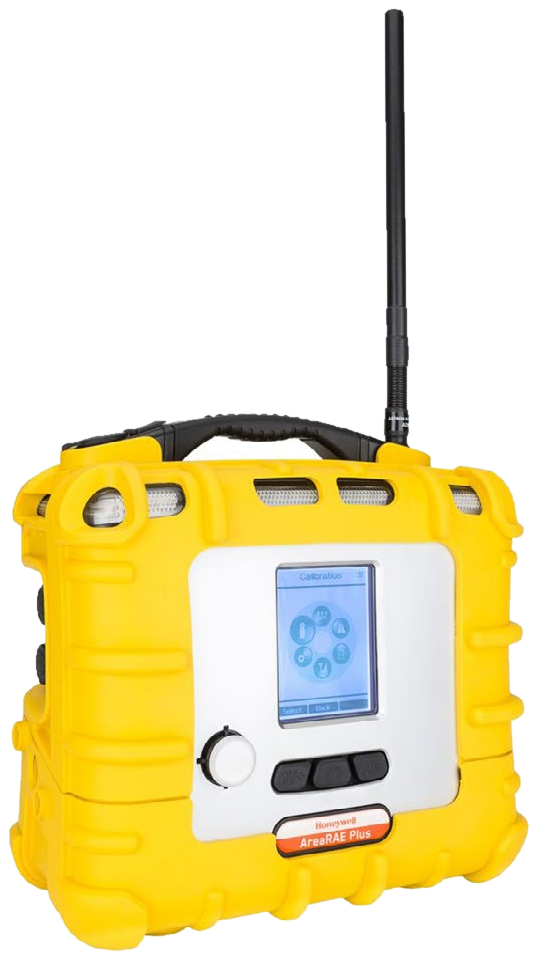
Honeywell AreaRAE Plus
Multiple gas threats. One easy-to-use transportable area detector.
A wireless area monitor you set down around a scene. It detects toxic and combustible gases, volatile organic chemicals, and, with the optional RAEMet sensor, the meteorological factors that affect the speed and direction of the gas. Crews on scene get local audible and visual alarms; command gets a real-time view of the readings from a safe location through Honeywell's remote monitoring software.
Up to 7Gas sensor slots
108 dBMulti-tone buzzer
IP 65Ingress protection
GPSStandard in every unit
2 mi
Up to 2 miles (3 km) on the ISM 900 MHz radio
8
Remote instruments it can act as a gateway for
~20 h
With wireless connectivity on Li-ion pack, at 20 °C
90 d
Continuous data logging at 1 min intervals, 24/7
450
cc/min typical flow rate, built-in pump
Perimeter deployment
Ring the scene, watch it from a distance
Fence line, maintenance turnaround or emergency response: units go down around the hazard, alarm locally, and send real-time readings back so you can determine the location and severity of a threat without standing in it.
- 1
Set units around the hazard
Position units at the fence line, around a turnaround or at the edge of an incident. Turn it on and go: each one monitors toxic and combustible gas and VOCs where it stands, and GPS is standard equipment in every unit.
- 2
Alarm on the spot
A multi-tone 108 dB buzzer @ 3.3 ft / 1 m and a bright 360 degree LED warn anyone near the unit, with on-screen indication of the alarm condition.
- 3
Know which way it is moving
With the optional RAEMet sensor on top, the unit also measures wind speed, wind direction, temperature and humidity, so the plume's direction and speed are part of the picture.
- 4
Bring personal monitors into the network
The built-in Mesh radio lets one AreaRAE Plus act as a gateway for up to 8 remote instruments, such as MultiRAE or ToxiRAE Pro monitors up to 330 feet (100 meters) away.
- 5
Watch it from a safe location
Readings go to Honeywell's remote monitoring software in real time. The map-based display is accessible from any computer with an internet connection, or from a laptop as a turnkey host, and enables coordination and data sharing in joint operations.
Radio reach
Match the radio to the distance
A long-range primary radio (license-free ISM 900 MHz or 2.4 GHz, or IEEE 802.11 b/g Wi-Fi), a short-range Mesh secondary radio, and Bluetooth Low Energy as standard. Radio fit varies by model configuration, and Wi-Fi is optional; ask us about the radios on the unit you need.
Bar lengths are indicative only. Receiving > 80%. Additional equipment and/or software licenses may be required to enable remote wireless monitoring and alarm transmission.
RAEMet meteorological sensor
Read the wind, track the plume
Gas readings tell you what is there. The optional RAEMet sensor sits at the top of the AreaRAE Plus and adds where it is heading: wind speed, wind direction, temperature and humidity, from the same unit, on the same power.

Wind speed
0 to 20 m/s
(0 to 44 mph) · start speed 0.1 m/s (0.22 mph)
Wind direction
360°
No dead band · compass resolution 1°
Temperature
-20 °C to 60 °C
(-4 °F to 140 °F) · resolution 0.1 °C
Humidity
10 to 95% RH
Resolution 1% RH
Optional sensor · power supplied by the AreaRAE Plus · 6.5 kg (14.33 lb) full option configuration (+RAEMet)
- 01 · Measure
Weather at the source
A built-in electronic compass and high sensitivity give RAEMet the wind speed, wind direction, temperature and relative humidity at each unit.
- 02 · Model
Plume on the map
The readings are modeled in Honeywell's real-time monitoring software, which integrates the ALOHA® hazard modeling program jointly developed by the US EPA and NOAA.
- 03 · Act
Decide with data
Use it to determine where to evacuate, what roads to close and how to prioritize actions. At a fence line, it shows the direction and speed of the plume.
Sensor configuration
Up to seven slots, built around your hazards
Up to six 4R+ sensors for toxic and combustible gas, plus a 7R+ photoionization detector for VOCs in parts per million with built-in compensation for temperature and humidity. Switch sensors out whenever your needs change.
PID7R+ PID10.6 eV · 0 to 5,000 ppm · 0.1 ppm resolution
4R+ToxicSmart sensor, field interchangeable
4R+ToxicSmart sensor, field interchangeable
4R+ToxicSmart sensor, field interchangeable
4R+O₂0 to 30 % · 0.10 %
4R+LELCatalytic bead · 0 to 100% LEL
4R+Your callFrom the supported sensor list
Example layout only · sensor mix is configured to your application, ask us
VOC · PID
- 7R+ 10.6 eV · 0 to 5,000 ppm
- 4R+ 9.8 eV · 0 to 2,000 ppm
Combustible · CO₂
- Catalytic bead · 0 to 100% LEL
- NDIR CO₂ · 0 to 50,000 ppm
Toxic & oxygen
- O₂
- CO
- CO HR
- CO H₂ Comp
- H₂S
- H₂S HR
- SO₂
- NO
- NO₂
- HCN
- NH₃
- PH₃
- HCl
- HF
- Cl₂
- ClO₂
- ETO-A
- ETO-B
- ETO-C
- H₂
Need gamma? The AreaRAE Plus is a gas and meteorological monitor without a gamma sensor; its sibling, the AreaRAE Pro, offers an optional one.
See AreaRAE ProOn scene
Carry it in, leave it working
One transportable unit with its own pump, power and alarms: built for short and long-term deployments without a fixed installation.
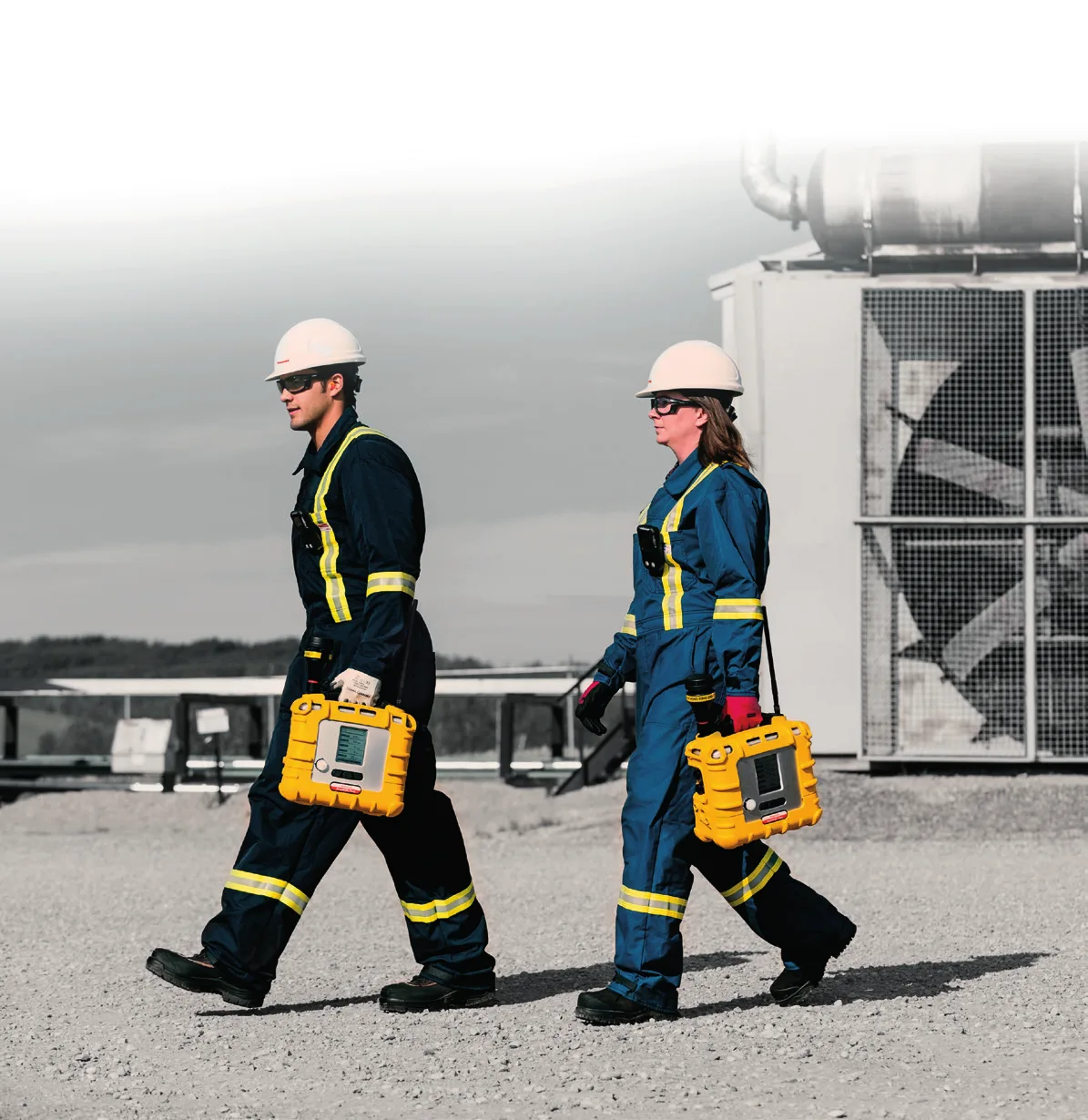
Transportable area monitor · rubber boot
- 01
Easy to hear and see
108-decibel alarm with wraparound LEDs, plus a wireless connectivity alarm and a diagnostic alarm and display message for low battery.
- 02
Relays for strobes and horns
Three solid-state relays (dry contact, 24VDC and 250mA max) switch on gas alarm conditions or a pump failure, for connection to external strobes, horns or other triggers.
- 03
Flexible power
Rechargeable 7.2 V / 10 Ah Li-ion battery pack with built-in charger, ~20 hours with wireless connectivity on the Li-ion pack at room temperature (20°C), and an Alkaline Battery Adapter option.
- 04
Turn it on and go
A large 240 x 320 pixel backlit LCD and three big operation keys that are easy to use with industrial gloves. The interface is available in 9 languages.
- 05
Configure and manage
Easy USB connection to ProRAE Studio II configuration software, no special cable required, and device management with Honeywell Sotera™.
- 06
Built for outdoor work
IP 65, MIL-STD-810G and 461F performance tests, and an operating range of -20 °C to +50 °C. US / Canada: Class 1, Division 2 Groups A, B, C, D.
Applications
Wherever the hazard covers ground
Protect your community at a fence line, your employees during a turnaround, or your fire and hazmat team during emergency response.
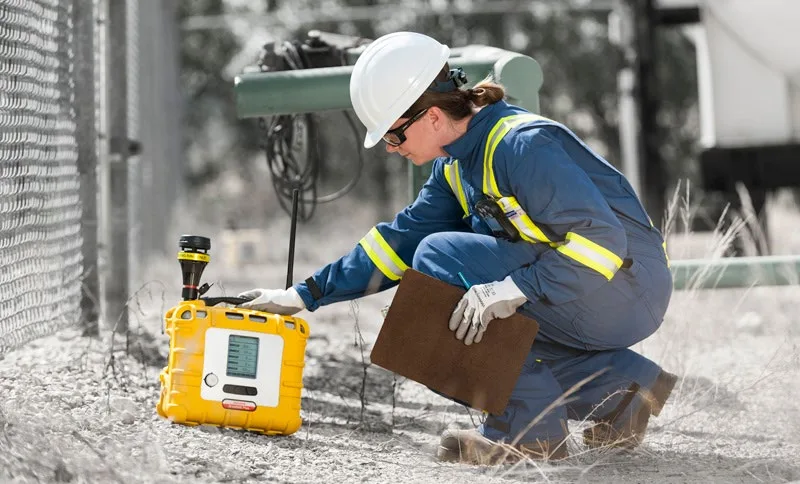
01
Fence line monitoring
Position units at the fence line, then monitor real-time readings from up to two miles away and use RAEMet to determine the direction and speed of the plume.
02 · More
Also used for
- Industrial emergency response teamsLocal alarms on scene, real-time readings at command.
- Maintenance turnarounds / shutdownsWatch the entire area, or multiple areas at multiple sites, for oxygen deprivation, explosive atmosphere and VOC, hydrogen sulfide or other toxic gas exposure.
- Wastewater pipeline rehabilitationUnits at manhole access points detect ammonia, chlorine, VOCs and other gas hazards.
- Site remediationMonitor the scene while sending readings for remote monitoring from a safe location.
- Fumigation, excavationAnd other environmental liabilities.
Specifications
Key specifications
Download the datasheet below for the full document.
| Physical | |
|---|---|
| Dimensions | 314 x 306 x 166 mm (with rubber boot) 12.36" x 12.04" x 6.53" (with rubber boot) |
| Weight | 6.3 kg (13.88 lb) full option configuration 6.5 kg (14.33 lb) full option configuration (+RAEMet) |
| Gas sensor slots | Up to 7; see Sensors tab |
| Additional sensors | RAEMet (Wind Speed, Wind Direction, Temperature & Humidity) |
| GPS | Standard equipment in every unit |
| Display | Large 240 x 320 pixel LCD backlit display, 64 x 85 mm / 2.5" x 3.33" |
| Keypads | 3 operation and programming keys |
| Sampling pump | Built-in pump, typical flow rate 450 cc/min |
| Alarms & outputs | |
| Alarms | Multi-tone 108 dB buzzer @ 3.3 ft / 1 m, Bright LED 360 degree view and on-screen indication of alarm conditions Additional diagnostic alarm and display message for low battery Wireless connectivity alarm |
| Relays | Three solid-state relays, switched by gas sensor alarm conditions or by a pump failure. Type: Dry Contact; maximum voltage: 24VDC; maximum amperage: 250mA |
| Environment & approvals | |
| Temperature | -20 °C to +50 °C (-4 °F to +122 °F) |
| Humidity | 0% to 95% relative humidity (non-condensing) |
| Ingress protection | IP 65 |
| Safety certification | US / Canada: Class 1, Division 2 Groups A, B, C, D |
| Performance tests | MIL-STD-810G and 461F LEL: CSA C22.2 No. 152, ISA-12.13.01 |
| Power | |
|---|---|
| Battery | Rechargeable 7.2 V / 10 Ah Li-ion battery pack with built-in charger Alkaline Battery Adapter |
| Operating hours | ~20 hours with wireless connectivity on Li-ion battery packSpecification at room temperature (20°C) |
| Data | |
| Data logging | Continuous data logging, 90 days at 1 min intervals, 24/7 |
| Data storage | 24M bytes (memory full action: stop when full or Wrap around) |
| Data interval | User-configurable from 1 to 3,600 sec |
| Communication | Communicates to ProRAE Studio II via USB cable to PC Wireless data and alarm status transmission via Wi-Fi or ISM modem Act as a gateway to connect up to 8 remote instruments (using secondary radio module) |
| Standard | Standard Bluetooth Low Energy module (BT4.0) and GPS |
|---|---|
| Primary radio module | Long range ISM License Free 900 MHz or 2.4 GHz radio IEEE 802.11 b/g Wi-Fi |
| Secondary radio module | Short range IEEE 802.15.4 900 MHz or 868MHz Mesh Radio |
| Range | Up to 2 miles (3 km) for ISM 900 MHz Up to 1.2 miles (2 km) for ISM 2.4 GHz Up to 330 ft (100m) for Wi-Fi Up to 15 ft (5m) for BLEReceiving > 80% |
| Mesh range | Up to 330 feet (100 meters) to Mesh-equipped instruments such as the MultiRAE and ToxiRAE Pro |
| Wireless approval | FCC Part 15, CE R&TTE |
| Note | Additional equipment and/or software licenses may be required to enable remote wireless monitoring and alarm transmission |
| RAEMet optional sensor | |
|---|---|
| Wind speed | Range: 0 to 20 m/s (0 to 44 mph) Start Speed: 0.1 m/s (0.22 mph) |
| Wind direction | Range: 360° (No dead band) |
| Temperature | -20 °C to 60 °C (-4 °F to 140 °F) Resolution 0.1 °C |
| Humidity | 10 to 95% RH Resolution 1% RH |
| Compass | Resolution 1° |
| Power | Power supplied by the AreaRAE Plus |
| Sensor | Range | Resolution |
|---|---|---|
| PID | ||
| 7R+; 10.6 eV | 0 to 5,000 ppm | 0.1 ppm |
| 4R+; 9.8 eV | 0 to 2,000 ppm | 0.1 ppm |
| Combustible & NDIR | ||
| Catalytic bead sensor | 0 to 100% LEL | 1% LEL |
| Carbon dioxide (CO₂), NDIR | 0 to 50,000 ppm | 100 ppm |
| Electrochemical | ||
| Ammonia (NH₃) | 0 to 100 ppm | 1 ppm |
| Carbon monoxide (CO) | 0 to 500 ppm | 1 ppm |
| Carbon monoxide ext. (CO HR) | 0 to 2,000 ppm | 10 ppm |
| Carbon monoxide H₂ Comp | 0 to 2,000 ppm | 10 ppm |
| Chlorine (Cl₂) | 0 to 50 ppm | 0.1 ppm |
| Chlorine dioxide (ClO₂) | 0 to 1 ppm | 0.03 ppm |
| Ethylene oxide (ETO-A) | 0 to 100 ppm | 0.5 ppm |
| Ethylene oxide (ETO-B) | 0 to 10 ppm | 0.1 ppm |
| Ethylene oxide (ETO-C) | 0 to 500 ppm | 10 ppm |
| Hydrogen (H₂) | 0 to 2,000 ppm | 10 ppm |
| Hydrogen chloride (HCl) | 0 to 15 ppm | 1 ppm |
| Hydrogen cyanide (HCN) | 0 to 50 ppm | 0.5 ppm |
| Hydrogen fluoride (HF) | 0.5 to 10 ppm | 0.1 ppm |
| Hydrogen sulfide (H₂S) | 0 to 100 ppm | 0.1 ppm |
| Hydrogen sulfide ext. (H₂S HR) | 0 to 1,000 ppm | 1 ppm |
| Oxygen (O₂) | 0 to 30 % | 0.10 % |
| Sulfur dioxide (SO₂) | 0 to 20 ppm | 0.1 ppm |
| Nitric oxide (NO) | 0 to 250 ppm | 0.5 ppm |
| Nitrogen dioxide (NO₂) | 0 to 20 ppm | 0.1 ppm |
| Phosphine (PH₃) | 0 to 20 ppm | 0.1 ppm |
| Warranty against factory defects | |
|---|---|
| Four years | O₂ Liquid Oxygen sensors |
| Three years | CO and H₂S sensors |
| Two years | Non-consumable components, catalytic LEL sensor and 10.6eV 7R+ PID lamp |
| One year | All other sensors, battery, and other consumable parts |
| Six months | 9.8eV lamp PID sensor |
Resources
Downloads & service
The AreaRAE Plus datasheet and product brochure.
Honeywell
AreaRAE Plus datasheet
Features, specifications, RAEMet and supported sensors.
HoneywellAreaRAE Plus brochure
Application examples.
Sibling modelNeed gamma? See AreaRAE Pro
Same family and housing, with an optional gamma sensor for radiation alongside gas.
Honeywell service
Warranty, calibration & repair
Warranty service
Honeywell warranty service
FarrWest is a Honeywell Authorized Service Provider for BW and RAE Systems gas detection. Coverage depends on the model and service agreement.
Calibration & repairRepair Depot
Functional checks and certified calibration on the manufacturer's required cycle, with every certificate stored against the unit's serial number.
Talk to us210.566.1857
Questions on sensors, radios or RAEMet? Call or email sales@farrwest.com.
FAQ
Common questions
Does the AreaRAE Plus detect gamma radiation?
No. The AreaRAE Plus does not have a gamma sensor; the AreaRAE Pro offers an optional one. If you need radiation detection alongside gas, see the AreaRAE Pro.
How many sensors can it hold?
There are up to 7 gas sensor slots: up to six 4R+ sensors for toxic and combustible gas plus a 7R+ photoionization detector for VOCs. You can switch sensors out when your needs change. The full list is in the Sensors tab above.
How far can it send readings?
Up to 2 miles (3 km) for ISM 900 MHz, up to 1.2 miles (2 km) for ISM 2.4 GHz, up to 330 ft (100m) for Wi-Fi and up to 15 ft (5m) for BLE. Additional equipment and/or software licenses may be required to enable remote wireless monitoring and alarm transmission.
Can it connect personal gas monitors?
Yes. Using its secondary (Mesh) radio module, it can act as a gateway to connect up to 8 remote instruments. Mesh-equipped instruments such as the MultiRAE and ToxiRAE Pro can be up to 330 feet (100 meters) away.
How long does it run?
~20 hours with wireless connectivity on the Li-ion battery pack (specification at room temperature, 20°C). The pack is a rechargeable 7.2 V / 10 Ah Li-ion with built-in charger, and an Alkaline Battery Adapter option is available. Setting the relays to Normally Open can decrease total runtime by as much as 30%.
Is the RAEMet weather sensor included?
RAEMet is optional. It sits at the top of the unit, is powered by the AreaRAE Plus, and measures wind speed, wind direction, temperature and humidity. With RAEMet, weight is 6.5 kg (14.33 lb) in full option configuration. Ask us about adding it.
Is it rated for hazardous locations?
Safety certification is US / Canada: Class 1, Division 2 Groups A, B, C, D. Recharge, remove or replace the battery, and replace sensors, only in an area known to be non-hazardous.
What comes in the box?
Standard contents include the instrument with protective rubber boot installed, USB communication cable, AC/DC power adapter (90-264VAC input) plus power cords, spare rechargeable battery, 3 spare external filters, Phillips and flathead screwdrivers, PID tools (if the instrument is equipped with a PID sensor), lamp-cleaning kit, "T"-type calibration tube, QuickStart Guide, and calibration and test certificate.
What is the warranty?
Against factory defects: four years for O₂ Liquid Oxygen sensors; three years for CO and H₂S sensors; two years for non-consumable components, catalytic LEL sensor and 10.6eV 7R+ PID lamp; one year on all other sensors, battery, and other consumable parts; six months for 9.8eV lamp PID sensor. For claims, see Honeywell warranty service.
Why FarrWest
Buying from FarrWest
Cooperative contracts
BuyBoard & PCA vendor
FarrWest is a pre-approved vendor on BuyBoard and Purchasing Cooperative of America (PCA). Government agencies can buy on competitively-bid cooperative contracts, with no lengthy RFP.
ServiceHoneywell Authorized Service Provider
FarrWest is a Honeywell Authorized Service Provider for BW and RAE Systems gas detection, with repair and calibration in our own Repair Depot in San Antonio, Texas.
Since 2004Woman-owned, HUB-certified
Serving Hazmat, Fire, Police, EMS, and Specialty Vehicle operations nationwide since 2004, with expert support, training, and service after the sale.
Next step
Plan your perimeter
Tell us the gases you need to see, how many units you are placing and how far your command post sits from the scene. We will come back with configuration options and a quote.