

Wireless / Transportable area monitor
Honeywell AreaRAE Pro
Easy to use transportable area monitor for multiple threat detection.
A wireless, transportable area monitor that can simultaneously detect toxic and combustible gases, volatile organic compounds, radiation and meteorological factors, and send the readings to Honeywell's remote monitoring software. Gamma radiation and RAEMet weather sensing are available as options.
Up to 7Gas sensor slots
108 dBAlarm @ 1 m
2 mi / 3 kmISM 900 MHz range
IP 65Ingress protection
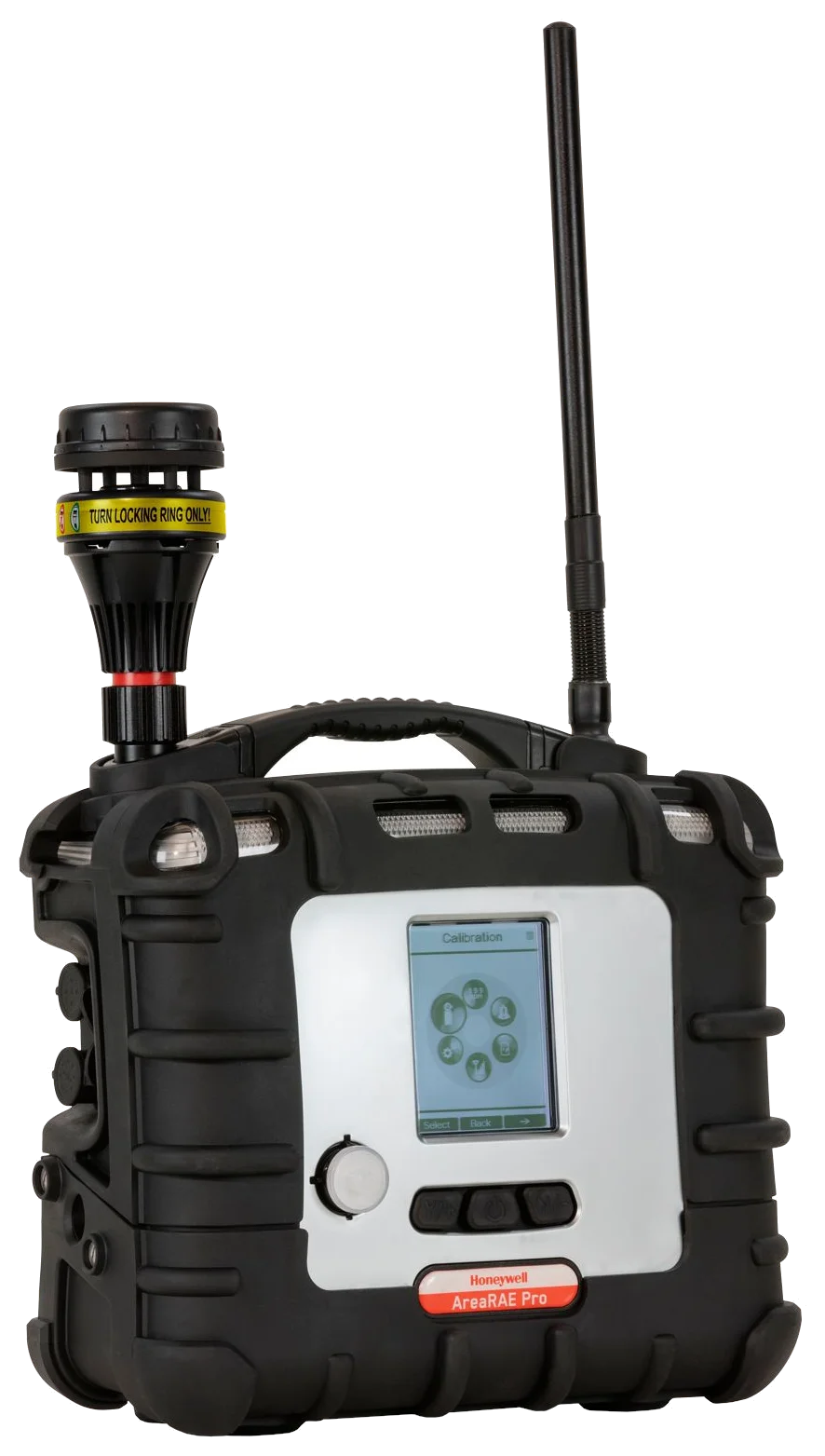
Shown with optional RAEMet sensor fitted
Situational awareness
Remote visibility on more threats than ever
Carry it into a hazmat response, set up a perimeter at a fire or protect a public venue. AreaRAE Pro works with Honeywell's remote monitoring software to give you a real-time view of threat readings, so you can make real-time decisions that help protect your teams and the general public.
- Delivers real-time readings so you can instantly determine the location and severity of a threat.
- Map-based display, accessible from any computer with an internet connection, or from your laptop as a turnkey host.
- Enables coordination and data sharing in joint operations.
- First responders
- Hazmat
- Civil Defense & Military
- Public Venue Protection

Coverage
Ring the scene, watch it from a distance
AreaRAE Pro is built to be set down around an incident and left to report. Several units around a release, one with a RAEMet on top, and a command post that follows every reading on a map-based display.
Example layout. Placement, radios and options depend on the job · scroll the map sideways
- 01
Place it and switch it on
User-friendly interface: turn it on and go. GPS is standard equipment in every unit.
- 02
Link back to the command post
The primary radio is a long-range, license-free ISM 900 MHz or 2.4 GHz radio for long-distance remote monitoring; IEEE 802.11 b/g Wi-Fi is a shorter-range option. Radio fit varies by model.
- 03
Bring personal monitors with it
A built-in mesh modem handles short-range monitoring with no external router. Each AreaRAE Pro can act as a gateway for up to 8 remote instruments.
- 04
Model the plume
With a RAEMet fitted, wind speed, wind direction, temperature and humidity are modeled in Honeywell's real time monitoring software, which integrates the ALOHA hazard monitoring program.
- 05
Manage the fleet
Device management with Honeywell Sotera™, and an easy USB connection to configuration software.
ISM 900 MHz
2 mi3 km
Primary radio, long range
ISM 2.4 GHz
1.2 mi2 km
Primary radio, long range
Mesh
330 ft100 m
Secondary radio, 900 MHz or 868 MHz
Wi-Fi
330 ft100 m
IEEE 802.11 b/g
Bluetooth LE
15 ft5 m
BT4.0 module
Wireless ranges are "up to" values, rated at receiving > 80%. Additional equipment and/or software licenses may be required to enable remote wireless monitoring and alarm transmission. Radio fit varies by model configuration.
Threat layers
Gas, VOCs, plus optional gamma and weather.
Configure the layers to the mission. Gas and VOC sensors fill the seven sensor slots. Gamma and RAEMet weather sensing are options you add on top, and the gamma sensor does not use a gas sensor slot.
Layer 01Up to six 4R+
Toxic & combustible gas
Up to six 4R+ sensors for toxic and combustible gas, from more than 20 interchangeable sensors that can be swapped at a moment's notice to meet the changing needs of first responders.
- LEL
- O₂
- CO
- H₂S
- HCN
- Cl₂
- NH₃
- Full list in Specs
Layer 027R+ PID
Volatile organic compounds
A 7R+ photoionization detector monitors VOCs in parts per billion, with built-in compensation for temperature and humidity.
- Range
- 0 to 2,000 ppm
- Resolution
- 10 ppb
- Lamp
- 10.6 eV

Front view, RAEMet fitted
Layer 03Optional
Gamma radiation
An optional gamma sensor detects and measures gamma radiation with increased sensitivity and faster response, without using an additional sensor slot. It comes pre-calibrated from the factory and does not require user calibration.
- Range
- 0.01 μSv/h to 0.2 mSv/h (1 μrem/h to 0.02 rem/h)
- Energy
- 50 keV to 3 MeV
Layer 04Available with RAEMet
Weather for plume tracking
The compact RAEMet sensor sits at the top of the AreaRAE Pro and measures wind speed, wind direction, temperature and humidity. It is powered by the AreaRAE Pro.
- Wind speed
- 0 to 20 m/s (0 to 44 mph)
- Direction
- 360° (no dead band)
- Compass
- Resolution 1°
Logged together. Continuous data logging: 90 days for 7 gas sensors, 1 gamma sensor, 1 RAEMet (wind speed & direction, temp and RH) and GPS at 1 min intervals, 24/7.
Plus vs Pro
Same housing. Different mission.
The AreaRAE Plus and AreaRAE Pro share one platform. The Pro adds a gamma radiation option and a ppb-resolution PID, and Honeywell lists it for first responders, hazmat, civil defense and public venue protection, where the Plus lists industrial and environmental work.
| Feature | AreaRAE PlusPGM-6520 family | AreaRAE ProPGM-6560 family · this page |
|---|---|---|
| Where they differ | ||
| Positioning | "Multiple gas threats. One easy-to-use transportable area detector." | "Easy to use transportable area monitor for multiple threat detection." |
| Gamma radiation | No | Optional gamma sensor, no extra sensor slot used. 0.01 μSv/h to 0.2 mSv/h; 50 keV to 3 MeV |
| 7R+ PID (VOCs) | VOCs in parts per million. 10.6 eV: 0 to 5,000 ppm, 0.1 ppm resolution | VOCs in parts per billion. 10.6 eV: 0 to 2,000 ppm, 10 ppb resolution |
| Applications | Industrial emergency response teams · maintenance turnarounds / shutdowns · fence line monitoring · wastewater pipeline rehabilitation · site remediation · fumigation, excavation and other environmental liabilities | First responders · hazmat · civil defense & military · public venue protection |
| Shared platform | ||
| Gas sensors | Up to 7 gas sensor slots; up to six 4R+ sensors for toxic and combustible gas | |
| Sensor choice | More than 20 interchangeable sensors (family-wide) | |
| 9.8 eV 4R+ PID | 0 to 2,000 ppm, 0.1 ppm resolution | |
| Weather | Available with RAEMet (wind speed, wind direction, temperature and humidity) | |
| Size & weight | 314 x 306 x 166 mm (with rubber boot); 6.3 kg (13.88 lb) full option configuration, 6.5 kg (14.33 lb) with RAEMet | |
| Run time | ~20 hours with wireless connectivity on Li-ion battery pack, at room temperature (20°C) | |
| Wireless | ISM 900 MHz or 2.4 GHz, or Wi-Fi primary radio; mesh secondary radio; Bluetooth LE (BT4.0) and GPS; gateway for up to 8 remote instruments | |
| Alarm & rating | 108 dB buzzer @ 1 m with 360 degree LED; IP 65; US / Canada: Class 1, Division 2 Groups A, B, C, D; -20 °C to +50 °C | |
Not sure which fits your team? Ask us and we will walk through it.
View the AreaRAE PlusOn scene
Set it down. Leave it working.
Flexible power options for short and long-term deployments, an alarm crews can hear and see, and relay outputs to trigger additional devices.
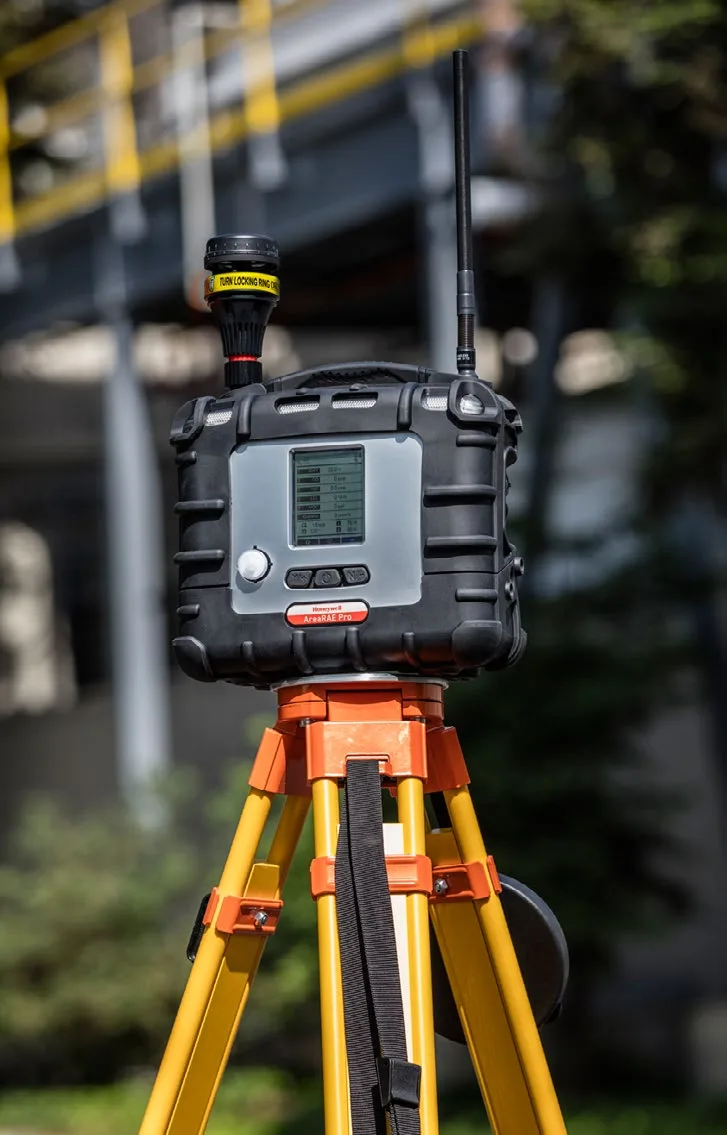
Tripod mounted, RAEMet fitted
- 01
Turn it on and go
A large 240 x 320 pixel backlit LCD and 3 operation and programming keys. GPS is standard equipment in every unit.
- 02
Easy to hear and see
Multi-tone 108 dB buzzer @ 3.3 ft / 1 m, a bright LED with a 360 degree view and on-screen indication of alarm conditions, plus a wireless connectivity alarm.
- 03
Power for short and long deployments
Rechargeable 7.2 V / 10 Ah Li-ion battery pack with built-in charger: ~20 hours with wireless connectivity. Alkaline battery adapter: ~12 hours with wireless connectivity. Both at room temperature (20°C).
- 04
Relay outputs
Three solid-state relays give the instrument the capability to trigger additional devices.
- 05
Tripod mounting
Honeywell offers an optional base plate (P/N W01-3018-000) for mounting the AreaRAE Plus/Pro on a standard surveyor-style tripod. Installation does not require removal of the rubber boot.
Specifications
Key specifications
Gamma and RAEMet are optional sensors.
| Physical | |
|---|---|
| Dimensions | 314 x 306 x 166 mm (with rubber boot) 12.36" x 12.04" x 6.53" (with rubber boot) |
| Weight | 6.3 kg (13.88 lb) full option configuration 6.5 kg (14.33 lb) full option configuration (+RAEMet) |
| Display | Large 240 x 320 pixel LCD backlit display, 64 x 85 mm / 2.5" x 3.33" |
| Keypads | 3 operation and programming keys |
| Sampling pump | Built-in pump, typical flow rate 450 cc/min |
| Sensors | |
| Gas sensor slots | up to 7; see Sensors tab |
| Additional sensors | Gamma; RAEMet (Wind Speed, Wind Direction, Temperature & Humidity). Optional. |
| GPS | Standard equipment in every unit |
| Power | |
| Battery |
|
| Operating hours |
|
| Alarms | |
|---|---|
| Alarms |
|
| Data | |
| Data logging | Continuous data logging (90 days for 7 gas sensors, 1 Gamma sensor, 1 RAEMet (wind speed & direction, temp and RH), and GPS at 1 min intervals, 24/7) |
| Data storage | 24M bytes (memory full action: stop when full or Wrap around) |
| Data interval | User-configurable from 1 to 3,600 sec |
| Communication |
|
| Wireless1 | |
|---|---|
| Standard | Bluetooth Low Energy module (BT4.0) and GPS |
| Primary radio module |
|
| Secondary radio module | Short Range IEEE 802.15.4 900 MHz or 868 MHz Mesh Radio |
| Wireless range2 |
|
| Wireless approval | FCC Part 15, CE R&TTE |
1 Additional equipment and/or software licenses may be required to enable remote wireless monitoring and alarm transmission. 2 Receiving > 80%.
| Environment & certification | |
|---|---|
| Safety certification | US / Canada: Class 1, Division 2 Groups A, B, C, D |
| Temperature | -20 °C to +50 °C (-4 °F to +122 °F) |
| Humidity | 0% to 95% relative humidity (non-condensing) |
| Ingress protection | IP 65 |
| Performance tests | MIL-STD-810G and 461F LEL CSA C22.2 No. 152, ISA-12.13.01 |
| Warranty (against factory defects) | |
| Warranty |
|
| Sensor | Range | Resolution |
|---|---|---|
| PID 4R+; 10.6 eV ppb | 0 to 2,000 ppm | 10 ppb |
| PID 7R+; 10.6 eV ppb | 0 to 2,000 ppm | 10 ppb |
| PID 4R+; 9.8 eV | 0 to 2,000 ppm | 0.1 ppm |
| Combustible, catalytic bead | 0 to 100% LEL | 1% LEL |
| Carbon dioxide (CO₂), NDIR | 0 to 50,000 ppm | 100 ppm |
| Ammonia (NH₃) | 0 to 100 ppm | 1 ppm |
| Carbon monoxide (CO) | 0 to 500 ppm | 1 ppm |
| Carbon monoxide ext. (CO HR) | 0 to 2,000 ppm | 10 ppm |
| Carbon monoxide H₂ comp (CO H₂ Comp) | 0 to 2,000 ppm | 10 ppm |
| Chlorine (Cl₂) | 0 to 50 ppm | 0.1 ppm |
| Chlorine dioxide (ClO₂) | 0 to 1 ppm | 0.03 ppm |
| Ethylene oxide (ETO-A) | 0 to 100 ppm | 0.5 ppm |
| Ethylene oxide (ETO-B) | 0 to 10 ppm | 0.1 ppm |
| Ethylene oxide (ETO-C) | 0 to 500 ppm | 10 ppm |
| Hydrogen (H₂) | 0 to 2,000 ppm | 10 ppm |
| Hydrogen chloride (HCl) | 0 to 15 ppm | 1 ppm |
| Hydrogen cyanide (HCN) | 0 to 50 ppm | 0.5 ppm |
| Hydrogen fluoride (HF) | 0.5 to 10 ppm | 0.1 ppm |
| Hydrogen sulfide (H₂S) | 0 to 100 ppm | 0.1 ppm |
| Hydrogen sulfide ext. (H₂S HR) | 0 to 1,000 ppm | 1 ppm |
| Oxygen (O₂) | 0 to 30 % | 0.10 % |
| Sulfur dioxide (SO₂) | 0 to 20 ppm | 0.1 ppm |
| Nitric oxide (NO) | 0 to 250 ppm | 0.5 ppm |
| Nitrogen dioxide (NO₂) | 0 to 20 ppm | 0.1 ppm |
| Phosphine (PH₃) | 0 to 20 ppm | 0.1 ppm |
| Gamma i-sensor (optional) | 0.01 μSv/h to 0.2 mSv/h (1 μrem/h to 0.02 rem/h) · 50 keV to 3 MeV | |
| RAEMet optional sensor | |
|---|---|
| Wind speed | Range: 0 to 20 m/s (0 to 44 mph) Start Speed: 0.1 m/s (0.22 mph) |
| Wind direction | Range: 360° (No dead band) |
| Temperature | -20 °C to 60 °C (-4 °F to 140 °F) Resolution 0.1 °C (1.8 °F) |
| Humidity | 10 to 95% RH Resolution 1% RH |
| Compass | Resolution 1° |
| Power | Power supplied by the AreaRAE Pro |
Resources & service
Documents and support
The AreaRAE Pro datasheet and FarrWest warranty and Repair Depot service for Honeywell BW and RAE Systems instruments.
Honeywell
AreaRAE Pro datasheet
Features, specifications, RAEMet and supported sensor tables.
Service · WarrantyHoneywell warranty service
FarrWest is a Honeywell Authorized Service Provider for BW and RAE Systems gas detection. Coverage depends on the model and service agreement.
Service · Calibration & repairRepair Depot
Certified calibration and repair in the FarrWest Repair Depot. Call us to confirm coverage for a specific model.
FAQ
Questions we get on the phone
Does every AreaRAE Pro come with gamma and weather sensing?
No. Both are options. An optional gamma sensor handles radiation detection and does not use one of the gas sensor slots, and the RAEMet weather sensor is an additional sensor (the unit weighs 6.5 kg with RAEMet versus 6.3 kg without). Tell us which you need when you request a quote.
How is the AreaRAE Pro different from the AreaRAE Plus?
They share the same housing, 7 sensor slots and wireless platform. The Pro can be fitted with a gamma radiation sensor (the Plus cannot) and its 7R+ PID reads VOCs in parts per billion, with 10 ppb resolution. See the comparison above or the AreaRAE Plus page.
How far away can I monitor it from?
Up to 2 miles (3 km) on the ISM 900 MHz radio, up to 1.2 miles (2 km) on ISM 2.4 GHz and up to 330 ft (100m) on Wi-Fi (rated at receiving > 80%). The map-based display can also be reached from any computer with an internet connection. Additional equipment and/or software licenses may be required for remote wireless monitoring and alarm transmission.
Can it relay readings from our personal gas monitors?
Yes. Using its secondary (mesh) radio module, the AreaRAE Pro can act as a gateway to connect up to 8 remote instruments.
What is it rated for?
US / Canada: Class 1, Division 2 Groups A, B, C, D, IP 65, and an operating temperature of -20 °C to +50 °C (-4 °F to +122 °F). Performance tests: MIL-STD-810G and 461F.
How long does it run?
About 20 hours with wireless connectivity on the Li-ion battery pack, or about 12 hours with wireless connectivity on the alkaline battery adapter, both specified at room temperature (20°C).
Does the gamma sensor need calibrating?
No. The gamma radiation sensor comes pre-calibrated from the factory and does not require user calibration.
Who services and calibrates it?
FarrWest is a Honeywell Authorized Service Provider for BW and RAE Systems gas detection, and covered repair and calibration is done in the FarrWest Repair Depot in San Antonio, Texas. Coverage depends on the model and service agreement, so call 210.566.1857 to confirm it for your unit. See Honeywell warranty service and the Repair Depot.
Why FarrWest
Buying from FarrWest
Cooperative contracts
BuyBoard & PCA vendor
FarrWest is a pre-approved vendor on BuyBoard and Purchasing Cooperative of America (PCA). Government agencies can buy on competitively-bid cooperative contracts, with no lengthy RFP.
ServiceHoneywell Authorized Service Provider
FarrWest is a Honeywell Authorized Service Provider for BW and RAE Systems gas detection, with repair and calibration in our own Repair Depot in San Antonio, Texas.
Since 2004Woman-owned, HUB-certified
Serving Hazmat, Fire, Police, EMS, and Specialty Vehicle operations nationwide since 2004, with expert support, training, and service after the sale.
Next step
Plan your AreaRAE Pro deployment
Tell us what you need to watch: the gases, whether you need gamma or weather data, and how far your command post sits from the scene. We will help you pick sensors, radio and options.